
By Deeyoung MaLinkedInWebsiteOctober 5, 20268 min readRestaurant OperationsReviewed October 5, 2026
A restaurant employee quit without notice. Rebuild the next shifts.
An employee confirmed an immediate quit? Rebuild qualified shift coverage, preserve worked hours, and check final-pay deadlines in B.C., Alberta and Ontario.

When a restaurant employee has clearly confirmed that they are quitting immediately, start with the duties left uncovered in the coming shifts. Find qualified replacements for specific times, reduce the service you cannot staff, and keep the departing employee's worked hours intact for payroll review. A notice dispute needs its own review; it does not supply a wage-penalty formula.
This guide covers a confirmed departure before the next service. Someone who misses a shift, stops replying or leaves during an argument has not necessarily resigned. Use the no-show evidence workflow when attendance is the known fact, or the mid-shift response guide while service is running. If intent or a protected reason is unresolved, arrange coverage without deciding employment status.
Replace the duties, not just the employee’s row
Look at the assignments the person would have handled over the next several services. A cook's row might include opening prep on Tuesday, receiving on Wednesday and closing the kitchen on Friday. Those are different coverage problems, even if all three shifts have the same duration.
Identify the duty that makes each shift possible. Who can handle its equipment, food-safety responsibilities, cash or security handoff? Which job needs a trained lead present, rather than someone who can help with prep? Confirm the restaurant's training, permit and authorisation requirements. A role label in a schedule does not prove them.
Then check the replacement's availability and existing assignments. Moving the cashier into the kitchen can leave the counter uncovered. Asking a closer to open the next morning can create a rest or fatigue problem. Review applicable hours, breaks and overtime rules before approving extra work. An unanswered message is not an accepted shift.
Make the offer specific: date, start and end, duties and the person approving the change. Confirm acceptance through the restaurant's agreed contact method. Keep a qualified backup where one is available; do not promise service on the assumption that an off-duty employee will answer.
We would publish a smaller service we can staff before relying on an untrained closer. If coverage fails, change the affected menu, service channel or hours before promising it to guests. Separately review the employment and pay consequences before shortening another employee's confirmed shift.
Eighteen hours can contain three different gaps
Consider a fictional B.C. restaurant. Its opening-and-closing cook worked on Friday, October 2, 2026, then confirmed on Saturday, October 3 that they were resigning immediately. The next roster contains three six-hour assignments. None has begun. The manager retains the original roster and reviews each assignment before revising it.
In this example, the manager is qualified and available to open; Sam can perform opening duties but cannot arrive before 9 a.m.; Priya is qualified and available for Wednesday's whole block. Jo is a trained closer but can work only until 8 p.m. Their other assignments, required breaks, hours and meal relief still need checking. These are teaching assumptions, not a customer case or a recommended staffing level.
| Original assignment | Available qualified coverage | Reviewed operating decision |
|---|---|---|
| Tuesday, October 6, 6 a.m.–noon: opening cook | Manager 6–9 a.m.; Sam 9 a.m.–noon | Cover both parts with an equipment/prep handoff at 9 a.m. Check that the manager's other duties are covered. |
| Wednesday, October 7, 6 a.m.–noon: opening and receiving | Priya 6 a.m.–noon | Confirm the assignment and receiving responsibilities; review her whole week and meal relief. |
| Friday, October 9, 4–10 p.m.: kitchen closer | Jo 4–8 p.m.; nobody qualified for 8–10 p.m. | Withdraw the late kitchen service. Set the last order time early enough to finish all closing work by 8 p.m.; reduce service further if necessary. |
The original coverage windows total 18 elapsed hours. The revision covers 6 + 6 + 4 = 16, with two hours of late service withdrawn. It does not replace all 18 hours, prove the whole restaurant is adequately staffed or establish 16 paid hours. Paid-time treatment, breaks, preparation and work beyond these windows require their own review.
Friday's remaining gap changes the operating decision. Extending Jo's row to 10 p.m. would hide it. So would assigning an available dishwasher who has not been trained or authorised to close the kitchen. Before approving the revised close, check reservations, delivery settings, guest communication and who owns the closing work.

Put reviewed coverage into the working schedule
Once the assignments have been reviewed, use the weekly shift scheduler to enter replacement times and inspect the revised hour totals. The public tool can produce a PDF for the week. A saved free account adds employee roles, saved schedules and CSV/XLSX handoff options.
For the example, the useful output is Tuesday's split coverage, Wednesday's confirmed assignment and Friday's earlier closing coverage. Retain the original roster and the reasons for the revision in the restaurant's appropriate records before changing the working copy. Editing a schedule does not, by itself, create an immutable before-and-after employment archive.
Before giving an export to payroll, check whether the report contains scheduled or actual hours. A revised future roster cannot establish what the departing employee previously worked. Retain supporting time evidence and approved corrections outside the shared schedule as needed.
Maxuod Shift is developed in Halifax for small Canadian teams. It records the week the manager has reviewed and supports its exports. It does not confirm resignations, automatically find qualified replacements, revoke access in other systems, decide final wages or deductions, issue a Record of Employment, or run payroll. If an approved spreadsheet already shows the coverage clearly, use it. A staffing gap does not require a software migration.
Record the exit date without guessing from silence
Keep the employee's communication in the restricted employment record. Record when it was received, the confirmed effective exit date and the last day actually worked. Those dates can differ. Tell the service team only what it needs to know about changed assignments and handoffs.
If the wording is unclear, ask the employee to confirm whether they intend to resign and the effective date. Keep the clarification private. A statement that someone cannot work tonight does not establish a permanent departure.
Ontario's termination interpretation discusses ambiguous conduct and quickly withdrawn, heat-of-the-moment statements. Route a disputed exit or a concern about leave, safety, harassment or constructive dismissal to an employment adviser. This article does not decide whether a resignation is legally effective.
Separate an immediate quit from notice of a future last day. Sending an employee home sooner can change the employer's obligations. Have the intended action reviewed before changing that date or instructing the person not to return.
Send keys, alarm codes, POS access and supplier contacts to their authorised owners for review. Handle access in the relevant systems and retain needed employment evidence. Account cleanup is not permission to erase the employee's history.
Give payroll the old hours and a checked payment date
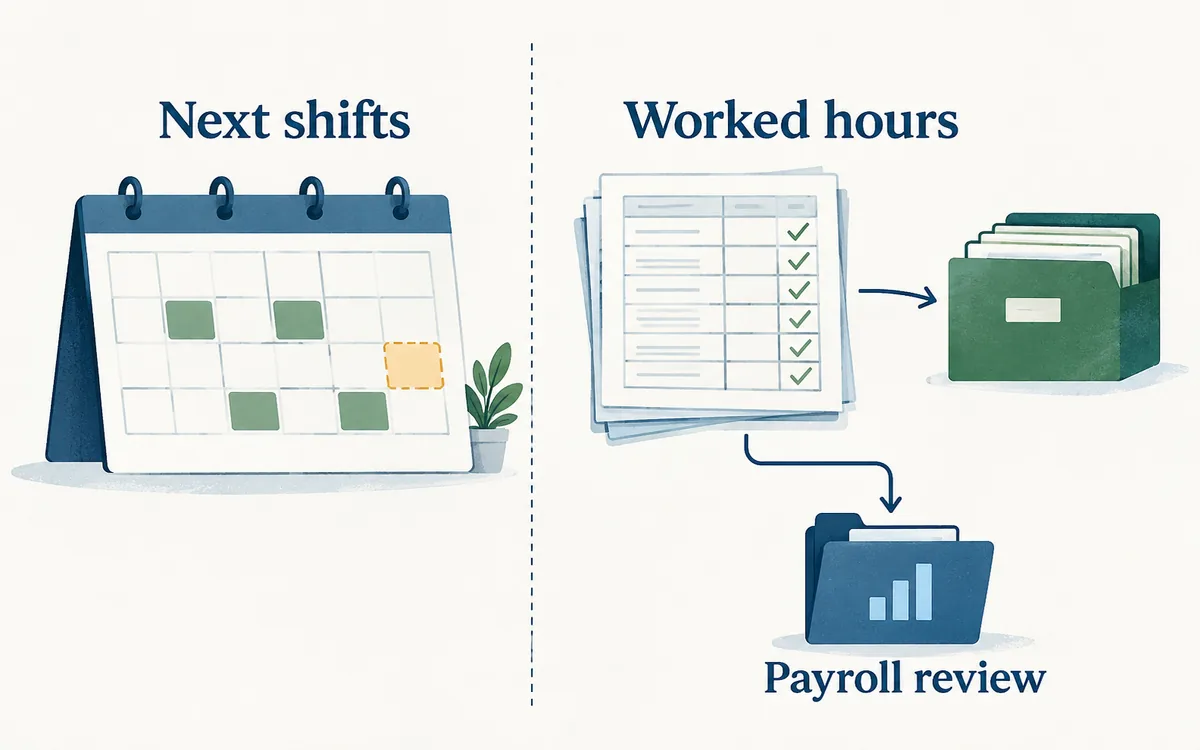
The coverage revision describes future work. The payroll packet preserves original time evidence, authorised corrections and outstanding questions. Ask the reviewer to reconcile wages, overtime, vacation pay and other applicable amounts; the last shift's straight-time wages may be only part of the settlement. Review tip allocation separately under the applicable rules and agreement.
Include the province, confirmed employment-end date, last day worked, pay-period end and next regular payday. Name who will resolve an uncertain amount and verify payment. Use the weekly payroll handoff checklist for supporting records, not as a final-pay calculator.
| Province | Final-payment checkpoint for the reviewer |
|---|---|
| B.C. | After an employee quits, outstanding wages are due within six calendar days after the later of the last working day and the quit date. See the section 18 interpretation. |
| Alberta | The employer may choose payment within ten calendar days after the end of the pay period in which employment ended, or 31 calendar days after the last day of employment. See termination and lay-off guidance. |
| Ontario | Outstanding wages are due by the later of seven days after employment ends and what would have been the next regular payday. See the wage-payment guide. |
In the fictional B.C. example, the last working day is October 2 and the confirmed quit date is October 3. Six calendar days after the later date is October 9. Using the earlier clock-out date would give the reviewer the wrong starting point. This illustrates the employee-ended rule, not B.C.'s different deadline when the employer ends employment.
Do not use a final-payment checkpoint to postpone wages already due. Ontario's payment interpretation preserves existing regular-payday obligations. Other provinces, federal employment, collective agreements and disputed exits need their own checks; these rows are not Canada-wide rules.
Missing notice does not supply a deduction formula
There is no single Canadian instruction that every employee owes two weeks. B.C.'s quitting guidance does not require notice under its employment-standards rules. A contract or common-law question still needs separate advice.
Alberta's employee-resignation rules generally require one week's written notice after more than 90 days but less than two years, or two weeks at two years or more. Exceptions include shorter employment, personal health or safety danger, and certain casual arrangements where the employee may choose whether to work. Part-time employment alone does not establish that casual exception. Check the conditions before drawing a conclusion.
Ontario's section 58(6) notice discussion concerns employees resigning during a mass-termination notice period. Do not turn that scoped provision into the notice period for every ordinary restaurant resignation. Refer contract, collective-agreement and damages questions for employment-law review.
Do not subtract replacement costs or declare wages forfeited because the departure was inconvenient. Ontario's deduction interpretation discusses specific written authorisations related to insufficient notice, distinguishes a penalty from a pre-estimate of damages, and says a policy-manual clause alone is not the employee's deduction authorisation. That requires specialist review. Alberta's deduction rules require a separate check too; permission does not follow from its notice table.
Keep any property-return arrangement separate from the pay review. An exit interview, uniform return or agreement with the manager's account does not itself establish a basis for holding wages. Have a proposed deduction reviewed before applying it, while keeping the amounts and deadlines owed on the reviewer's calendar.
Check the next roster for the same dependency
Once the replacement week is settled, look for the duty that depended on one person. In the example, nobody else could perform the Friday close after 8 p.m. Adding names to the roster would not have fixed that restriction.
Plan training and supervised practice for another suitable closer, with coverage for the person teaching. A training-list entry does not prove competence. Keep the restriction visible when accepting bookings and publishing the week until another closer is ready.
Use the shift handoff checklist to tell the next manager which coverage is confirmed, which service changed and what remains open. Payroll still needs the original hours, exit facts and checked payment date. Keep those two handoffs distinct.
Official sources checked October 5, 2026. This is operating information, not legal, HR or payroll advice. The legal examples cover their stated B.C., Alberta and Ontario provincial employment-standards contexts only. Verify current requirements, exceptions, agreements and circumstances with the official authority and a qualified adviser. Maxuod Shift provides scheduling and review aids, not payroll processing or a compliance determination.
Official sources checked
Reviewed October 5, 2026
- B.C. Employment Standards: payment of wages when employment ends, section 18British Columbia; employee-ended employment
- B.C. Employment Standards: quitting or getting firedBritish Columbia; provincial employment standards
- Alberta Employment Standards: termination and lay-offAlberta; resignation notice, exceptions and final earnings
- Alberta Employment Standards: deductions from earningsAlberta; permitted and prohibited deductions
- Ontario ESA guide: payment of wagesOntario; wage-payment deadlines
- Ontario ESA policy manual: payment of wagesOntario; deductions and existing regular-payday obligations
- Ontario ESA policy manual: termination and severance of employmentOntario; disputed resignation and scoped notice provisions
Written as an operator checklist, not legal or payroll advice. Confirm local rules before changing pay, holiday, or tip policies.
Related guides
Restaurant Employee Leaves Mid-Shift: Stabilize the Service First
Protect safety, reset role coverage, record actual hours, and follow up without treating one mid-shift departure as automatic resignation or misconduct.
How to Handle Employee No-Shows in a Restaurant
Use a restaurant employee no-show policy to verify the published shift, reconstruct the timeline, cover the role, and review facts after service.
Restaurant Shift Handoff Checklist: Pass the Exceptions
A restaurant shift handoff checklist for exceptions, owners, deadlines, actual-hour changes, and close-to-open decisions without a chat dump.
Build the schedule before the week gets loud
Maxuod Shift keeps employee availability, overtime risk, payroll estimates, and tip distribution in the same place for small restaurant teams.