
By Deeyoung MaLinkedInWebsiteJuly 31, 202611 min readRestaurant OperationsReviewed July 31, 2026
Restaurant Food Delivery Temperature Too High: Hold or Reject?
Food delivery temperature too high? Isolate the lot, verify the reading, document the evidence, and decide who can accept, hold, or reject it.
Key takeaways
- A high receiving temperature starts a controlled decision; it does not prove that every item on the truck is unsafe or acceptable.
- Isolate the affected lot, verify the thermometer and measurement method, and preserve time, product, package, vehicle, supplier, and disposition evidence.
- Accept, hold, and reject must be named statuses with an authorized decision owner; a driver explanation is evidence, not the restaurant’s final decision.
- Health Canada’s 4°C-to-60°C danger-zone guidance gives national safety context, but the applicable province, food, exposure history, specifications, and approved plan determine the operating response.
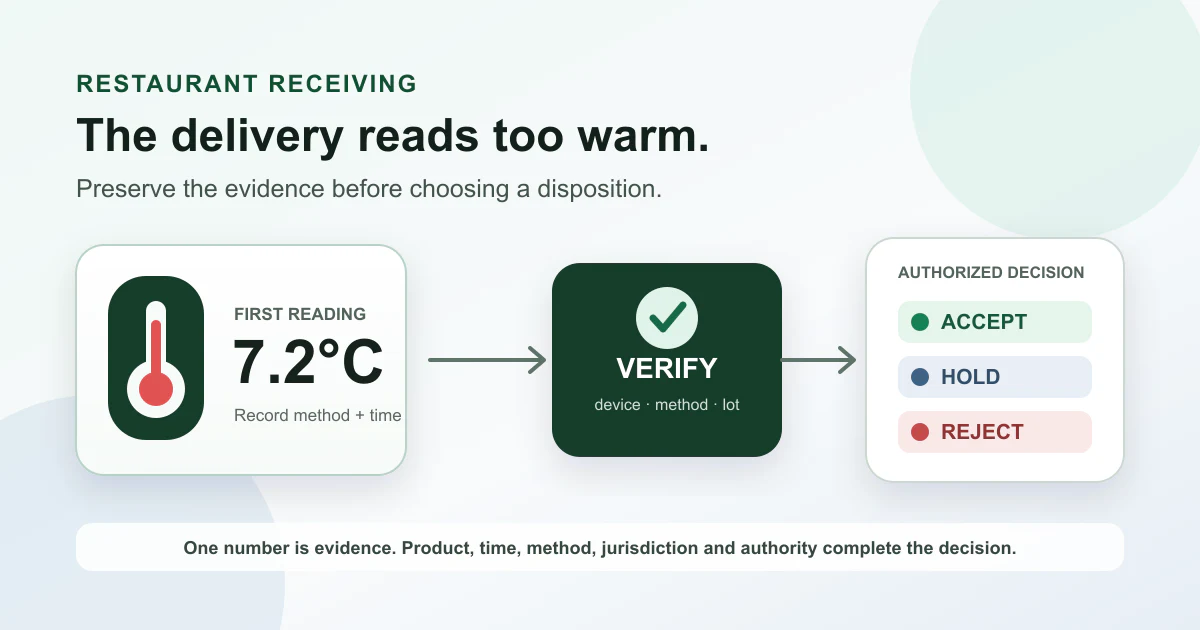
If a restaurant food delivery temperature is too high, do not move the case directly into normal storage and do not reject the entire truck from one unexplained number. Mark the affected product hold, separate it from usable stock, verify the thermometer and measurement method, then let the restaurant’s authorized food-safety decision owner apply the product specification, exposure history, provincial rules, and approved procedure.
That answer is less dramatic than “anything above 4°C goes back,” but it is more useful. A surface reading, an internal product reading, the air inside an open truck, and the temperature printed on a supplier record are different evidence. This guide follows one fictional delivery record to show what a trained receiver should preserve before choosing accept, hold, or reject. It is operational guidance, not a substitute for a public-health inspector, certified food-safety lead, supplier specification, or provincial requirement.
A high reading starts a decision, not an argument
At 9:42 a.m., a fictional Halifax restaurant receives six cases of chilled chicken. A calibrated probe reads 7.2°C in a package selected under the restaurant’s approved method. The driver says the trailer door was open at the previous stop and points to a colder display on the refrigeration unit. The prep cook wants to accept the cases because lunch production starts in an hour.
The receiver should not average those numbers, accept because the truck display looks better, or reject because the handheld reading looks worse. The readings describe different places and moments. The immediate job is to stop the affected lot from entering ordinary inventory, record both readings with their source, and escalate the decision before prep begins.
| Known at 9:42 | Still unknown | Immediate control |
|---|---|---|
| Product, supplier, lot, delivery time, measured value, device used | Exposure duration, other-case temperatures, measurement validity, approved limit, corrective authority | Label and separate the six cases; no prep, service, return, or disposal until disposition |
The word hold matters. It prevents urgency from becoming an irreversible decision while keeping suspect food out of normal use.
Read one delivery record from top to bottom
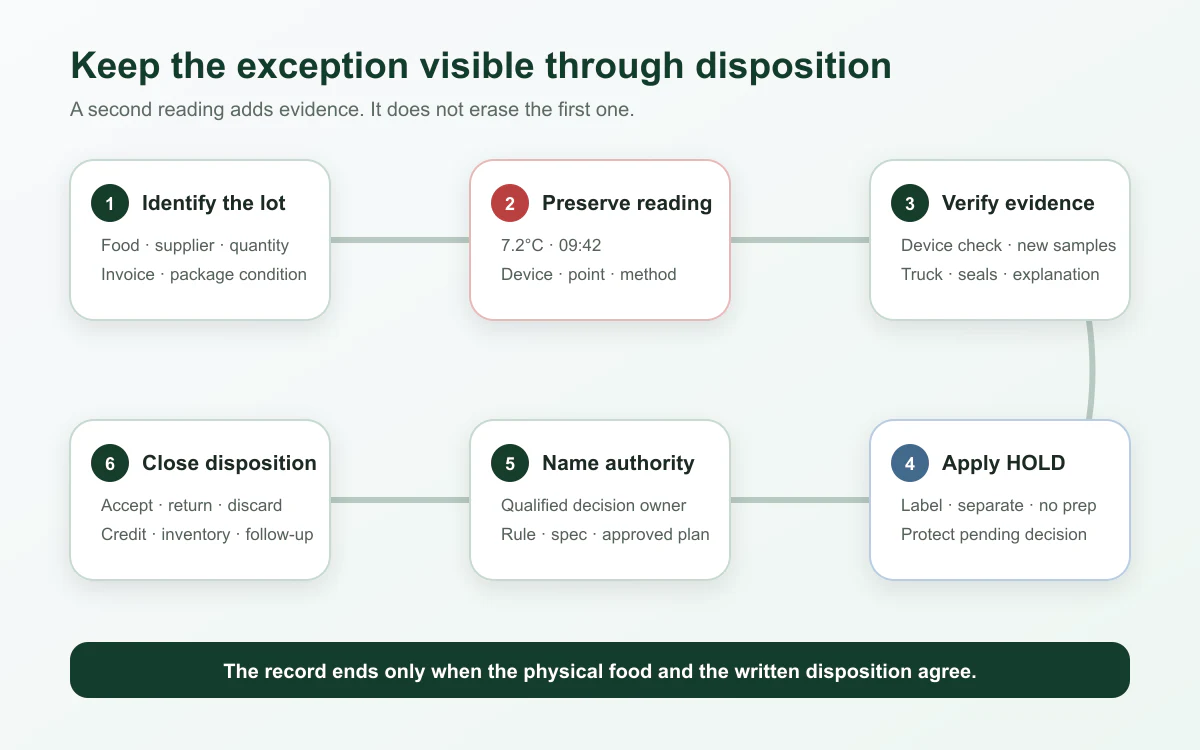
A useful receiving record tells the next qualified person what happened without asking them to reconstruct the loading dock from memory. Record the scheduled and actual arrival, supplier, purchase order or invoice, food and lot, quantity affected, package condition, vehicle condition, each reading, measurement location, thermometer ID or check, driver explanation, photos if policy permits, temporary location, decision owner, final disposition, and corrective action.
| Field | Fictional entry | Why it changes the decision |
|---|---|---|
| Food and lot | Chilled chicken, six sealed cases, lot C-731 | Defines the affected unit; it does not automatically include unrelated frozen or dry goods |
| First reading | 7.2°C, package/product reading using receiving procedure | Creates the exception and must include where and how the value was taken |
| Verification | Second trained receiver checks the device and takes representative readings under the same procedure | Tests a measurement problem without erasing the first result |
| Transport evidence | Unit display, driver statement, delivery sequence, seals and package condition recorded separately | Supports the exposure review but cannot replace product evidence by itself |
| Status | HOLD: separated from approved stock | Prevents use while the authorized decision is pending |
| Disposition | Accepted, rejected/returned, discarded, or another action authorized by the applicable plan | Closes the record and tells inventory and purchasing what happened |
Accept, hold, and reject are controlled statuses
| Status | Use it when | What must be true next |
|---|---|---|
| Accept | The authorized receiver can show that the food meets the applicable specification and procedure after valid checks | Record the evidence and move the food promptly into the correct storage |
| Hold | The evidence is incomplete, conflicting, or requires a food-safety lead, supplier, inspector, or other authorized review | Identify, segregate, protect, and prevent use until a named person records disposition |
| Reject | The food fails the applicable acceptance criteria or cannot be shown safe and suitable under the approved process | Record the affected lot and reason; keep it controlled until return, disposal, or another authorized action is completed |
CFIA guidance for incoming ingredients tells regulated parties to verify proper temperature, inspect transport and package conditions, and identify rejected ingredients in a separate area until return, disposal, or destruction. The same control pattern is useful to a restaurant, but the CFIA page is guidance for businesses subject to the Safe Food for Canadians Regulations. It does not prove that every ordinary restaurant has the same federal obligations. Check the activity, province, local public-health requirements, and the establishment’s approved food-safety plan.
Do not invent a fourth status such as “use first” for food that has not passed the decision. FIFO is an inventory practice, not a way to convert unresolved temperature evidence into approval.
A second reading can clarify the picture without deleting the first
Verification should follow a defined method. Check that the instrument is the right type, clean and sanitized where required, within its calibration or accuracy check, and used at the correct point for the product and package. Take representative readings according to the restaurant’s approved procedure rather than repeatedly probing until one favourable number appears.
A lower second reading may show that the first package was warmer than the rest, that the first technique was wrong, or that the lot is changing temperature. A similar second reading may strengthen the exception. Neither result establishes the exposure time by itself. Record both readings, both locations, the time between them, and who performed them.
Health Canada says bacteria can grow in the danger zone between 4°C and 60°C and advises keeping cold foods at or below 4°C. That is important national safety context. It is not, by itself, a complete commercial receiving rule for every food, process, and province. For example, Ontario Regulation 493/17 requires potentially hazardous food to be transported, maintained, stored, distributed, displayed, sold, and offered for sale at 4°C or lower or 60°C or higher, subject to stated exceptions. That Ontario rule should not be silently presented as the law in Nova Scotia, Québec, or another jurisdiction.
The driver cannot answer three questions for the restaurant
- Was the measurement valid? The receiver owns the restaurant’s method and record. A truck display or supplier log can support the review but may measure a different point.
- Does the food meet the restaurant’s acceptance criteria? The authorized food-safety role applies the food, supplier specification, local rules, and approved plan.
- Can the held food enter prep? Only the named disposition owner releases it. Delivery pressure, menu demand, or replacement cost does not create food-safety authorization.
The driver should still be heard. Record the explanation, trailer reading, prior stops, seal or door condition, and any supplier escalation. Avoid turning the loading dock into a blame hearing. The question is what the restaurant can verify now and what the supplier must investigate later.
If the supplier wants the restaurant to accept a disputed lot, ask for the evidence and approval path required by the purchase specification. A credit promise does not make the food acceptable, and rejecting food does not settle the root cause.
Do not let the lunch rush collapse the evidence
A temperature exception creates two separate problems: food disposition and service continuity. Keep them separate. The food-safety lead decides the lot. The kitchen lead decides what can be produced from approved inventory. The floor lead closes or updates affected menu channels. Purchasing contacts the supplier and backup source. One person should not quietly make all four decisions because the truck is blocking the lane.
If the affected ingredient is critical, use the existing sold-out menu item workflow rather than releasing held product. If cold storage is also failing, switch to the refrigeration temperature and corrective-action SOP. A receiving exception and an equipment failure can happen together, but they need separate records and owners.
The broader restaurant receiving and rejection SOP provides the accept/hold/reject decision sequence and downloadable log. The supplier qualification and backup plan turns repeated delivery failures into a purchasing review instead of another argument at the door.
Keep the exception after the truck leaves
At the end of the shift, reconcile the physical lot, receiving record, invoice or credit, inventory adjustment, menu change, waste or return record, and supplier corrective action. If a held case is no longer present, the record should say whether it was accepted, returned, discarded, or transferred under an authorized process. “Manager handled it” is not a disposition.
Review patterns by supplier, product, route, delivery window, packaging, and season. One exception may be a device or handling problem. Repeated warm poultry on the last stop of the same route is a different purchasing signal. Do not publish a failure rate until the records use consistent definitions and the denominator is known.
Set the next review date when the supplier specification, menu process, regulation, public-health direction, thermometer method, delivery route, or approved food-safety plan changes. A receiving article can explain the control logic; the current official requirement must still be checked where the restaurant operates.
Where Maxuod Shift helps, and where it stops
A rejected or held delivery may change prep, service, manager coverage, and the actual hours worked. Use Maxuod Shift’s restaurant schedule maker to preserve the approved roster, update role coverage, and keep scheduled and actual hours visible for the weekly payroll handoff. That record can explain why a receiver stayed late or why a prep shift changed.
Maxuod Shift does not measure food temperature, certify a thermometer, approve a supplier, determine whether food is safe, notify public health, track a lot, or authorize acceptance, return, or disposal. Keep the food-safety decision in the restaurant’s approved receiving record. Use the scheduling record only for the people and hours affected by the disruption.
That boundary is deliberate: the software should make the operational consequence easier to reconstruct without pretending to make a regulated food-safety judgement.
Decision notes for the next delivery
- If only the truck display is warm: verify the product under the approved method and record the transport condition; do not infer every case temperature from the air display.
- If one case is warm and others are within specification: keep the affected unit identifiable and let the authorized decision owner determine the scope; do not hide it inside an average.
- If the second reading is acceptable: retain the first reading, method check, timing, and reason the final evidence supports acceptance.
- If production is waiting: use approved inventory, a documented substitute, a menu pause, or another service decision; urgency does not release held food.
- If the supplier disputes the result: preserve both evidence sets and follow the agreed escalation path; the receiver still controls what enters the restaurant.
The practical standard is simple to state and harder to fake: identify the lot, preserve the exception, verify the evidence, name the authority, and close the disposition. If the record cannot show those five things, the restaurant does not yet have a defensible answer to “why did we use or refuse this delivery?”
Official sources checked
Reviewed July 31, 2026
- Health Canada: General food safety tipsCanada
- CFIA: Incoming ingredients, materials and non-food chemicalsCanada; regulated-party guidance whose applicability depends on the activity
- Ontario Regulation 493/17: Food PremisesOntario
Written as an operator checklist, not legal or payroll advice. Confirm local rules before changing pay, holiday, or tip policies.
Related guides
Restaurant Supplier Delivery Late or Short: A Pre-Service Decision Plan
When a restaurant supplier delivery is late or short, confirm the state, protect menu promises, reassign work, and preserve a useful incident record.
Restaurant Freezer Power Outage: Protect Food Before You Rebuild the Shift
Use a restaurant outage checklist to keep doors closed, log time and temperature, isolate affected food, contact the right authority, and rebuild coverage.
Restaurant Ran Out of a Menu Item During Service: A 15-Minute Response
Use a practical 15-minute restaurant sold-out-item response to stop new orders, brief staff, offer substitutes, record waste, and reset tomorrow’s prep.
Build the schedule before the week gets loud
Maxuod Shift keeps employee availability, overtime risk, payroll estimates, and tip distribution in the same place for small restaurant teams.