
By Deeyoung MaLinkedInWebsiteJuly 19, 202610 min readRestaurant OperationsReviewed October 12, 2026
Restaurant Employee Meal Policy: Control Cost Without Accusing Staff
Set a restaurant employee meal policy with a clear meal standard, shared purchasing, approved celebration meals and a simple weekly budget review.

Key takeaways
- Set the ordinary meal, eligibility and food-purchase budget before ordering.
- Assign one buyer and plan preparation as paid work with service coverage.
- Approve the menu, eligible meal count and extra budget for a celebration in advance.
- Review weekly purchasing totals and receipts; investigate specific exceptions separately.
A restaurant employee meal policy should make the working day predictable: who can have a meal, what the normal meal includes, when it is prepared, and who approves a special occasion. Cost control starts with an agreed meal standard and a coordinated kitchen plan, not a daily investigation of what each employee ate.
Start with the meal your restaurant wants to provide, then plan the eligible meal count, menu and purchases together. A café assembling meals from an approved selection may use a different arrangement from a restaurant preparing a shared staff dish. The policy should describe the arrangement employees will actually receive.
Define who receives a meal and when
Write down which shifts or work arrangements qualify under the approved policy. Explain how opening, evening, weekend, double and manager shifts are handled, whether the meal is provided or subsidized, and how an approved extra shift changes the meal count. Confirm existing agreements before changing the arrangement.
Use the roster to make a preliminary list, then confirm who expects a meal before the kitchen’s preparation cutoff. Someone scheduled for a short visit, someone on leave and someone covering a full service do not automatically create the same meal requirement. The meal count comes from the policy and confirmation, not simply the number of names on the schedule.
Set a serving window and a person employees can ask about changes. Coordinate that window with station coverage and the applicable break arrangements; offering a meal does not settle break entitlement or pay treatment. Late arrivals and approved extensions need a workable alternative rather than an improvised promise.
Describe the ordinary meal before setting a spending amount
An ordinary meal standard should describe a complete meal ready for the agreed serving window, not merely the cheapest item under a cap. State the approved main and accompanying food, the available alternative, what drinks or extras are included, and when the meal will be ready. Employees should know what to expect without negotiating a different guest-menu order every day.
Choose a rotating selection the kitchen can prepare consistently. It can share suitable ingredients with the restaurant’s menu, but staff meals need their own planned quantity so they do not unexpectedly consume stock promised to guests. Leftover availability alone is not a dependable meal standard.
Review whether the meal is adequate for the intended workday, reaches the later team in usable condition and fits the preparation capacity. If the standard repeatedly cannot be delivered within the budget, change the approved menu or budget openly. Do not quietly reduce the meal’s quality or leave a shift without the promised option.
Agree the menu, then purchase and prepare it together
Name one kitchen lead to propose the staff-meal menu and one authorized buyer to include its approved ingredients in the order. They may be the same person in a small restaurant. Keep an agreed ingredient list and a practical rotation rather than letting several employees make separate purchases or individual cooking requests during the rush.
Confirm the eligible meal count, dietary alternatives and any event upgrade before buying. Use ingredients available through the normal purchasing process where they fit the approved meal. Additional items should have a named approver, so a last-minute shop is an authorized exception rather than a second informal procurement system.
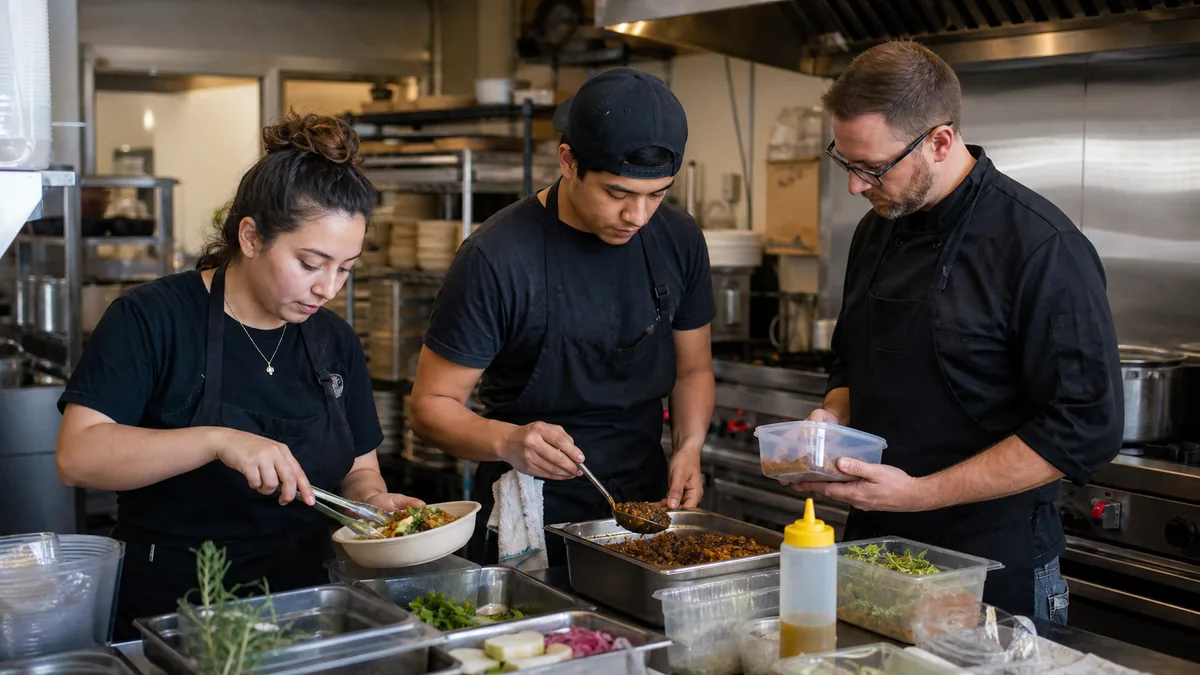
Plan required preparation as paid work in a suitable window and make the responsibility visible to the incoming kitchen team. Shared preparation can be a staff dish, an assembled meal or another approved arrangement; it should not displace necessary guest-service or safety work. If the kitchen cannot prepare it reliably, consider an approved simpler menu or external provision instead of assuming spare capacity.
Make dietary alternatives part of the plan
Ask employees to identify the meal requirement that needs accommodation through the restaurant’s appropriate process. Confirm the alternative with the kitchen before the order and preparation are fixed. A vegetarian option, a religious food requirement and an allergy concern may need different decisions; an improvised ingredient swap does not resolve all of them.
Keep sensitive personal details out of the shared roster. The kitchen needs the agreed preparation requirement and the person responsible for confirming it. Follow the restaurant’s approved food-safety and accommodation procedures, and do not promise an alternative the responsible person has not checked.
Approve a celebration meal before increasing the order
A holiday service, team celebration or restaurant milestone can justify an enhanced meal arrangement. Decide the occasion, covered meal group, improved menu, serving times and approving manager in advance. Include employees working another relevant service in the plan instead of leaving the enhancement to whoever happens to be present when food arrives.
One hypothetical CAD planning example: eight eligible meals at an ordinary food-purchase budget of $6 per meal give 8 × $6 = $48. For the same eight meals, an approved celebration budget of $9 gives 8 × $9 = $72. The approved uplift is $24. These are teaching amounts, not Canadian standards, market quotes or cash allowances paid to employees.
This simple comparison covers food purchases only; preparation, service, taxes and delivery need their own budget treatment. Record the approval before purchasing and return to the ordinary standard after the named occasion. If the eligible meal count changes, update the plan rather than treating the original total as permission for an unlimited order.
Review the weekly total, not every plate at close
Keep a short weekly record of planned eligible meals, ordinary and special menus, approved event spending, purchasing receipts and significant changes. Compare total spending with the plan and ask whether the agreed meals were delivered at the right time. Routine oversight does not require weighing individual portions or turning every closing shift into an audit.
A higher weekly total may reflect more eligible shifts, an approved celebration or a supplier price change. Check those explanations before altering the ordinary standard. If spending is repeatedly difficult to manage, review the rotation, purchasing responsibility or preparation method with the kitchen lead.
The useful next decision is specific: approve a different ordinary dish, order through the regular buyer, adjust a serving window or agree the next event budget. Keep the current standard stable until that change has been approved and communicated.
Tell the team which standard is current
Put the approved policy where employees can find it: eligibility, meal offering, serving arrangements, dietary-request contact, event approval and effective date. Brief the kitchen, floor and supervisors together so a new menu or budget does not create competing verbal rules. A bilingual team can use two language versions of the same approved arrangement.
Use the shift handoff checklist for a changed meal window or an approved event menu that the next shift must deliver. Feedback about an unavailable meal should first improve the plan and communication; it should not become an automatic allegation.
Keep tax review and roster support in their proper roles
The CRA guidance on meals provided by the employer says free or subsidized meals are generally taxable, with situation-specific exceptions and administrative policies. Have the qualified payroll reviewer confirm the actual arrangement. A budget does not establish tax value, and calling a meal a celebration does not automatically make it tax-exempt.
Use Maxuod Shift to organise the roster, entered shifts and relevant handoff context. That can help the manager identify the expected team and coordinate meal preparation with work, but eligible meal counts still need human confirmation. Maxuod Shift is not meal-budget or inventory software, does not purchase ingredients and does not process payroll.
Sources were checked October 12, 2026. This is operating guidance, not tax, legal or payroll advice. If a specific loss or repeated unauthorized purchase is supported by a concrete record, handle that exception privately through the appropriate incident process; it need not become the structure of the ordinary meal programme.
Official sources checked
Reviewed October 12, 2026
- CRA — Meals provided by the employerCanada; federal tax treatment, not provincial wage-deduction permission
Written as an operator checklist, not legal or payroll advice. Confirm local rules before changing pay, holiday, or tip policies.
Related guides
Restaurant Labour Cost Percentage in Canada: 2026 Cost Review
Calculate restaurant labour cost percentage, compare scheduled and actual inputs, and diagnose sales, coverage, overtime, or employer-cost changes.
Restaurant Opening Checklist: Free PDF Template
Use this restaurant opening checklist to assign FOH, kitchen, staffing, equipment, and sign-off tasks. Download the free printable PDF template.
Restaurant Shift Handoff Checklist: Pass the Exceptions
A restaurant shift handoff checklist for exceptions, owners, deadlines, actual-hour changes, and close-to-open decisions without a chat dump.
Build the schedule before the week gets loud
Maxuod Shift keeps employee availability, overtime risk, payroll estimates, and tip distribution in the same place for small restaurant teams.