
By Deeyoung MaLinkedInWebsiteMay 2, 202613 min readPayroll & TipsReviewed July 31, 2026
Restaurant Labour Cost Percentage in Canada: 2026 Cost Review
Calculate restaurant labour cost percentage, compare scheduled and actual inputs, and diagnose sales, coverage, overtime, or employer-cost changes.

A restaurant labour cost percentage is a comparison, not a universal pass mark. Concept, service model, location, wage mix, salaried-management treatment, training, season, holidays, and demand can all move the result. A healthy number for one operation can describe understaffing or weak service in another.
The useful question is not only "what percentage did we get?" It is: did the schedule match the sales pattern, did overtime or a holiday change the week, are employer costs included consistently, and did the manager catch the difference before the next roster was published?
This guide is operational, not legal, payroll, or accounting advice. Use it to build a weekly labour review, then confirm accounting treatment with your bookkeeper and employment-standard questions with the current official source for the employee's province.
Quick answer: there is no universal Canadian benchmark
Use the restaurant's own consistently defined target and compare it with the same closed period: net sales before sales tax, included labour costs, and paid hours. Then inspect sales per labour hour, cost per paid hour, service outcomes, and the scheduled-versus-actual variance.
| Comparison | Question it answers | What it cannot prove |
|---|---|---|
| Labour-cost percentage | How much of the selected net-sales basis went to the included labour-cost basis? | Whether the floor or kitchen had enough coverage. |
| Sales per labour hour | How much net sales were produced per paid hour in the same period? | Whether service quality, safety, or workload was acceptable. |
| Cost per paid hour | How much included labour cost was carried by each paid hour? | Which role or daypart caused the change. |
| Scheduled versus actual | Did sales or labour move away from the approved plan? | Why the variance happened without a daypart review. |
A bakery-cafe, late-night bar, seasonal patio, and neighbourhood bistro do not need the same target. A benchmark can start a question; it should not end the diagnosis.
How to calculate restaurant labour cost percentage
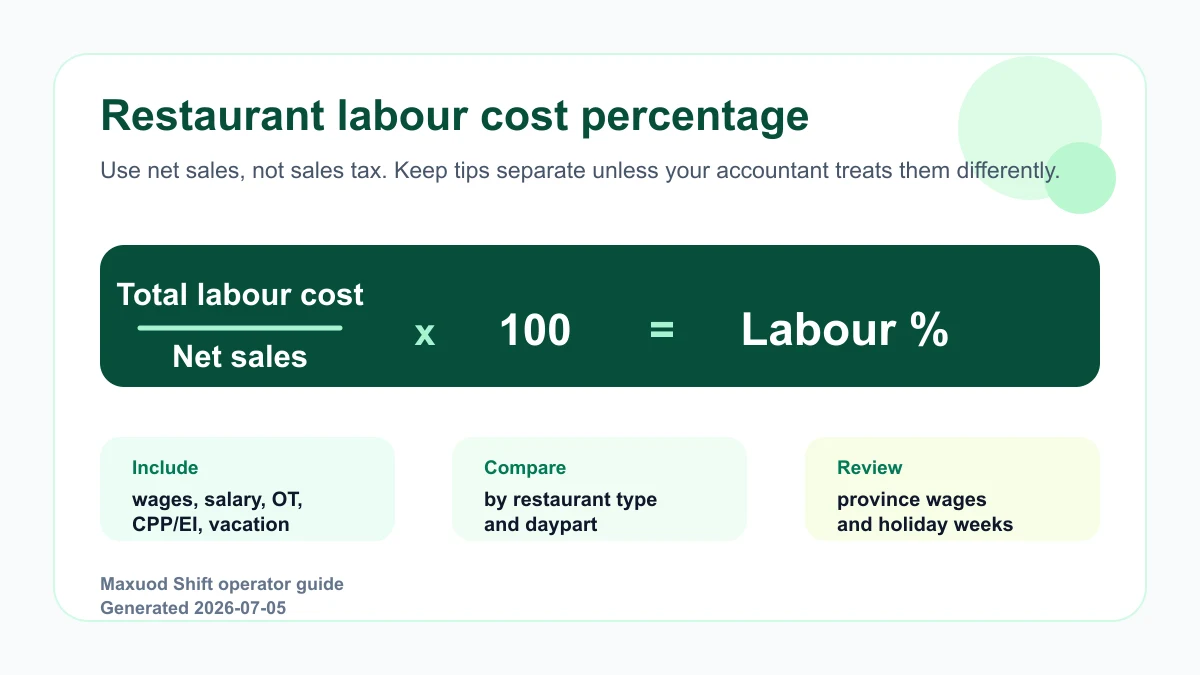
The basic formula is simple: total labour cost divided by net sales, multiplied by 100. Net sales means sales before sales tax. If your POS reports gross sales with HST/GST/PST included, remove the tax before calculating the percentage.
Use the restaurant labour cost calculator to keep actual and scheduled scenarios separate, switch tip treatment on only when intended, and review percentage, sales per labour hour, cost per paid hour, and the plan variance without sending the entered operating numbers to analytics.
Example: a restaurant has $32,000 in weekly net sales. Payroll wages for the week are $8,900. The manager adds a 20% load for employer costs and accruals, so fully loaded labour is $10,680. The labour cost percentage is $10,680 divided by $32,000, multiplied by 100. That equals 33.4%.
For a casual full-service restaurant, 33.4% may be acceptable if the week included a holiday, training, patio setup, or a deliberate staffing push. If the target was 29% and nothing unusual happened, the manager should review coverage, dayparts, prep timing, overtime, and sales forecast accuracy.
What counts as labour cost in Canada
For manager review, labour cost usually includes hourly wages, salaried management, overtime premiums, vacation accrual, employer CPP and EI costs, workers' compensation premiums, benefits, paid training, and other employment-related costs your accountant includes in the labour line.
Tips are usually separate when they pass through to employees. If the restaurant collects, controls, redistributes, or reports tips in a specific way, ask your accountant how that should appear in your books. The operating point is simple: do not mix employee tip pools into employer labour cost unless your accounting setup says to.
Owner draws are not labour cost. They come out of profit. If an owner works regular floor shifts and wants to understand operating reality, they can track an internal replacement wage for planning, but that is a management analysis choice, not the same as payroll.
| Include in labour review | Usually keep separate |
|---|---|
| Hourly wages and salaried labour | Sales tax collected from guests |
| Overtime and holiday premium review | Tips that pass through to employees |
| Employer payroll costs and vacation accrual | Owner draws and profit distributions |
| Benefits, training, and workers' compensation premiums | Food cost, rent, utilities, and marketing spend |
The July 2026 cost signal is wider than payroll
The labour percentage conversation is not happening in a vacuum. Statistics Canada reported on July 15 that 42.0% of accommodation and food services businesses expected to raise prices over the following three months. The same analysis traced pressure through transportation and warehousing: one-third of businesses in that sector expected input costs to be an obstacle, while long-distance freight, rail, courier, and local delivery prices had all moved higher in recent readings.
That is a national sector signal, not an instruction for every restaurant to add the same percentage to its menu. A downtown counter-service shop, a remote lodge restaurant, and a suburban dining room can have very different freight exposure, customer demand, and room to adjust portions. Use the statistic as a reason to inspect the restaurant's own invoices and sales mix, not as proof that a blanket price increase will work.
Earlier 2026 operator surveys point in the same direction. Restaurants Canada reported that 71% of operators were seeing declining profitability and 87% cited labour as a cost pressure. The TouchBistro 2026 Canadian State of Restaurants report also said nearly all surveyed operators reported higher labour expenses than the prior year. These surveys provide context; the restaurant's invoice, POS, waste, and hour records still decide the local response.
Test price, portion yield, and labour hours before choosing a response
Pull four records for the same recent period: supplier invoices, delivery and fuel surcharges, item-level net sales, and actual labour hours. Compare them with the prior four comparable weeks. The goal is to find which lever moved before changing all three.
| What the restaurant sees | First check | Response worth testing | Do not assume |
|---|---|---|---|
| One ingredient or delivery fee rises, but the item still sells well | Invoice unit cost, case yield, waste, and vendor surcharge | Improve yield, reduce waste, quote another supplier, or test a targeted item price | Every menu item needs the same increase |
| Food margin is stable, but labour percentage rises in quiet dayparts | Sales and actual hours by lunch, dinner, prep, and close | Move start times, shorten an overlap, or shift prep into a stronger demand window | The busiest guest-facing shift should be cut |
| Portion cost rises and plate waste is also visible | Recipe yield, serving utensil, trim loss, returns, and guest feedback | Standardize the build or test a portion change on the affected dish | A smaller portion will go unnoticed |
| Freight exposure rises across many products and the current margin no longer holds | Delivered cost by category, contribution margin, demand, and competitor context | Model a selective price change alongside purchasing and scheduling changes | A national statistic proves the customer's willingness to pay |
Write down the expected result before making the change. For example: move Wednesday prep 45 minutes later, keep Friday dinner coverage intact, and review labour percentage plus ticket times after two comparable weeks. A price test should name the affected items and margin target. A portion test should name the recipe yield and guest-feedback check. This makes the next review about evidence instead of memory.
Why a restaurant can run over target
When labour cost is high, do not start by cutting visible guest-service coverage. Diagnose the cause first.
- Sales miss: the schedule was built for a busier week than the restaurant actually had.
- Daypart mismatch: Tuesday lunch is overstaffed while Friday dinner is correctly staffed.
- Prep timing: kitchen labour starts too early or stays too late relative to demand.
- Overtime creep: a few people repeatedly cross the weekly or daily threshold in provinces where that matters.
- Wage drift: raises, hiring market pressure, or role changes lifted the average hourly cost.
- Management load: salaried management is too heavy for the current revenue base.
- Holiday week effect: public holidays, long weekends, training, and event coverage distort the normal week.
A high labour percentage can be a wage issue, a demand issue, or a schedule design issue. The fix is different in each case.
Province and holiday review flags
Canada does not have one restaurant minimum wage or one holiday-pay calendar. Minimum wage, overtime thresholds, public-holiday treatment, reporting pay, and special rules vary by jurisdiction. Use the federal current and forthcoming minimum wage rates in Canada page as a starting point, then verify the provincial employment-standards source for the location.
For example, the B.C. government announced that the general minimum wage increased from $17.85 to $18.25 on June 1, 2026. That does not change the labour percentage formula, but it can change the wage input and the schedule target for B.C. restaurants.
Holiday weeks need the same caution. Canada.ca's 2026 public holiday list shows Canada Day on Wednesday, July 1 and Civic Holiday on Monday, August 3, excluding Quebec. That calendar signal is useful for planning, but payroll treatment still depends on the applicable province or territory.
The safe manager habit is to write review flags into the schedule: minimum wage input checked, holiday week, overtime exposure, early cut, role change, or payroll note. Do not silently change pay treatment from memory.
Weekly labour cost review workflow
The strongest labour review is weekly. Monthly P&L statements arrive too late to fix the roster that created the number.
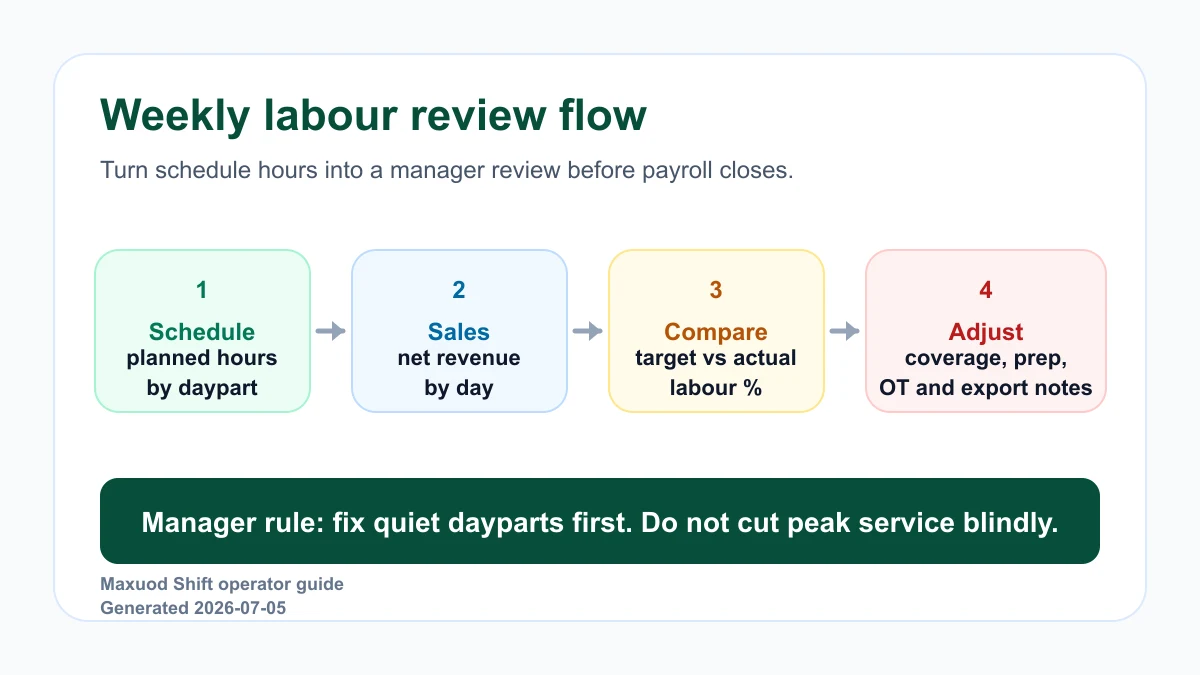
- Start with the sales forecast by daypart.
- Build required coverage by role: open, prep, lunch, dinner, close, dish, bar, host, manager.
- Estimate scheduled hours and wage cost before publishing.
- Check overtime exposure and holiday review flags.
- Compare planned labour percentage against the concept target.
- After the week closes, compare actual hours and actual sales.
- Adjust the next draft by daypart, not by panic.
This turns the schedule into an operating control. If Tuesday lunch is always high, fix Tuesday lunch. If Saturday dinner is low but service is strained, do not cut the shift that is carrying revenue.
Connect scheduled hours to the labour-cost review
Maxuod Shift does not read supplier invoices, calculate recipe yield, choose menu prices, or replace your POS, accountant, payroll provider, or employment-law review. It handles the schedule side of the decision: planned and actual hours, weekly totals, overtime visibility, province-aware review prompts, tip context, and CSV/XLSX export for payroll handoff.
For a practical workflow, draft the week in the restaurant schedule maker, check hour totals in the employee hours calculator, and use the free scheduler to save the week, review actual hours, and export notes before payroll.
Keep invoice and menu analysis in the restaurant's purchasing or accounting record. Keep scheduled-versus-actual hours in the labour review. If the number is high because the schedule is poorly shaped, read restaurant scheduling mistakes that cost money. If the issue is broader cost control, use how to reduce restaurant labour costs in Canada. If the next problem is forecasting, read restaurant labour forecasting for small businesses.
FAQ
What is a good restaurant labour cost percentage in Canada?
Many Canadian restaurants use a planning range around 25 to 35 percent of net sales. Quick-service and cafe concepts may sit lower, while full-service and fine dining often need more labour because service and kitchen coverage are heavier.
What is the formula for restaurant labour cost percentage?
Restaurant labour cost percentage equals total labour cost divided by net sales, multiplied by 100. Use sales before tax, then decide with your accountant which employer costs and accruals belong in the labour cost input.
Do tips count as restaurant labour cost?
Tips usually pass through to employees and are usually reviewed separately from employer labour cost. Wages, salaried management, CPP, EI, vacation accrual, benefits, and overtime premiums are part of the labour cost review.
How do you calculate labour cost per meal?
Divide labour cost for the period by covers, orders, or meals sold in the same period. For example, $10,000 in labour across 1,250 covers equals $8 labour cost per cover.
How can a small restaurant reduce labour cost without hurting service?
Start with coverage by daypart, prep timing, overtime creep, and wage drift before cutting visible guest-service hours. The goal is to move labour away from quiet periods and into the moments that actually need coverage.
Does the 2026 Canadian price-pressure data mean every restaurant should raise prices?
No. Statistics Canada reported a national sector-level expectation, not a pricing instruction for each restaurant. Check the restaurant's own supplier invoices, delivery surcharges, item margins, demand, waste, and actual labour hours before testing a targeted change.
Should a restaurant change prices, portions, or labour hours first?
Start with the record that moved. Supplier and delivery costs point to purchasing, yield, portion, or targeted-price tests. A labour increase concentrated in quiet dayparts points to schedule timing. Write down the expected result and compare equivalent weeks before keeping the change.
Written as an operator checklist, not legal or payroll advice. Confirm local rules before changing pay, holiday, or tip policies.
Related guides
How to Reduce Restaurant Labour Costs in Canada
Practical ways Canadian restaurants can lower labour cost without cutting service quality: demand-based scheduling, overtime control, prep timing, and payroll review.
Restaurant Labour Forecasting for Small Businesses
Build a restaurant labour forecast from demand signals, role-hours, base and flex coverage, then compare planned and actual hours with a worked example.
5 Employee Scheduling Mistakes That Create Payroll Surprises
Find five employee scheduling mistakes that create payroll surprises, then use a worked restaurant example and weekly variance review to fix them.
Build the schedule before the week gets loud
Maxuod Shift keeps employee availability, overtime risk, payroll estimates, and tip distribution in the same place for small restaurant teams.