
By Deeyoung MaLinkedInWebsiteSeptember 4, 202612 min readRestaurant OperationsReviewed September 4, 2026
A Boil-Water Advisory Hits During Service. Can the Restaurant Stay Open?
Use a restaurant boil-water advisory decision check for ice, drinks, food preparation, handwashing, dishwashing, staffing, and safe restart.
Key takeaways
- Read the exact notice first. A boil-water advisory, a do-not-consume advisory, and a do-not-use advisory require different controls.
- Stop every water-fed process until a named person maps it to safe alternate water or current local instructions.
- Staying open is a capacity decision only after the restaurant can meet food, handwashing, warewashing, washroom, and authority requirements.
- Record the operating change and actual hours separately from the food-safety decision.
At 10:24 a.m., a Halifax lunch restaurant receives a boil-water advisory. The ice machine is full, lettuce was washed during prep, the soda gun is connected to the water line, and the first guests arrive in 36 minutes. The wrong first question is “Are restaurants allowed to stay open?” The useful question is “Which water-dependent jobs can we prove are safe under this exact notice?”
There is no single Canada-wide yes or no. Alberta Health Services says a food establishment may operate during a boil-water advisory when its stated conditions are followed. Other provinces and local authorities may impose different instructions, and a do-not-consume or do-not-use notice is not a boil-water notice. If the restaurant cannot maintain a safe water supply and approved hygiene processes, it needs to reduce or suspend operations until it can.
This guide is an operational decision aid. It does not authorize service, determine whether food is safe, or replace the water utility, public-health inspector, food-safety authority, equipment manufacturer, or legal advice for the restaurant’s location.
Read the notice before copying a workaround
Open the notice from the issuing water utility or responsible authority. Record its type, affected addresses, issue time, stated cause if available, required treatment, and contact channel. A screenshot forwarded in a staff chat is not enough if the original notice has changed.
| Notice | Operating meaning | First boundary |
|---|---|---|
| Boil-water advisory or notice | A microbiological risk may be controlled by boiling when the notice says so | Use the stated boil time and local food-premise instructions |
| Do-not-consume advisory | Boiling may not make the water suitable for consumption | Use only the alternative supply permitted by the authority |
| Do-not-use advisory | The water may be unsuitable even for washing or contact uses | Stop affected water use and follow the authority’s exact directions |
Québec’s current food-establishment guidance states that boiled water is an alternative only for a boil-water advisory, not for a do-not-consume notice. British Columbia and other jurisdictions also distinguish lower and higher advisory levels. The label changes the plan, so preserve it in every manager handoff.
Freeze eight water paths in the first ten minutes
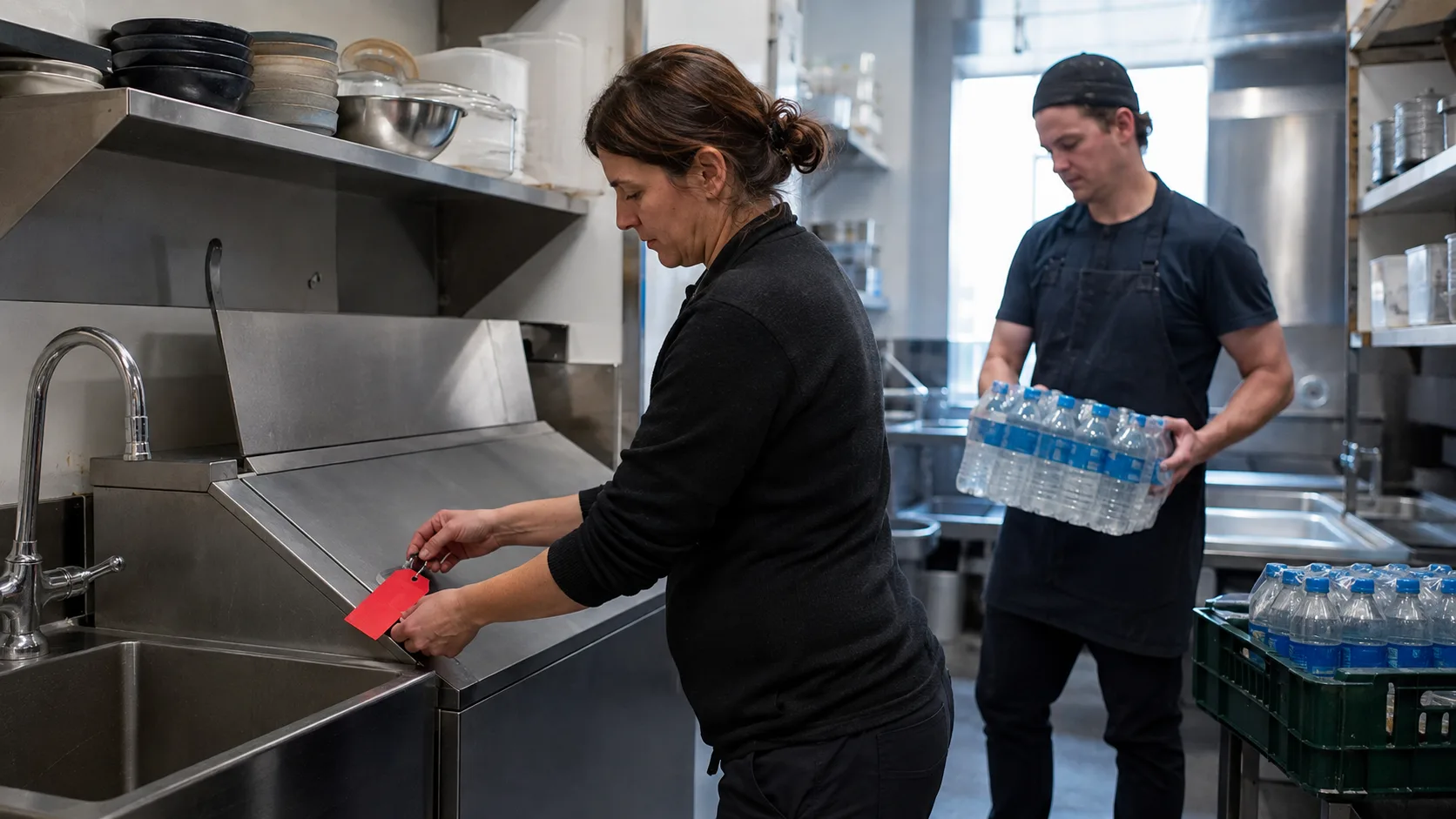
Stop use before trying to prove an exception. Assign one person to control water-fed equipment and one person to trace food or drink prepared since the last known safe time. Cover or tag controls in the direction employees actually use them. Do not rely on a message that can be missed during service.
- Drinking water: fountains, table water and refill stations.
- Ice: ice machines, bins, scoops, bagged ice storage and ice used to hold food.
- Beverages: soda guns, juice dispensers, slush machines, coffee and tea equipment connected to the line.
- Ready-to-eat food: washed produce, cold sauces, reconstituted mixes and water added after cooking.
- Cooking and thawing: water used as an ingredient, rinse, cooling step or running-water thaw.
- Food-contact cleaning: prep sinks, cloth buckets, cutting boards and final rinses.
- Warewashing: dish machines, glass washers, manual sinks and air-drying capacity.
- Hygiene and facilities: handwashing stations, employee drinking water and guest washrooms.
Ice and drinks made before the advisory was noticed need their own time window. The Canadian Food Inspection Agency tells applicable food businesses to assess food processed with the affected water immediately. A negative sample taken by the restaurant does not replace the authority’s notice that the supply is not yet consistently potable.
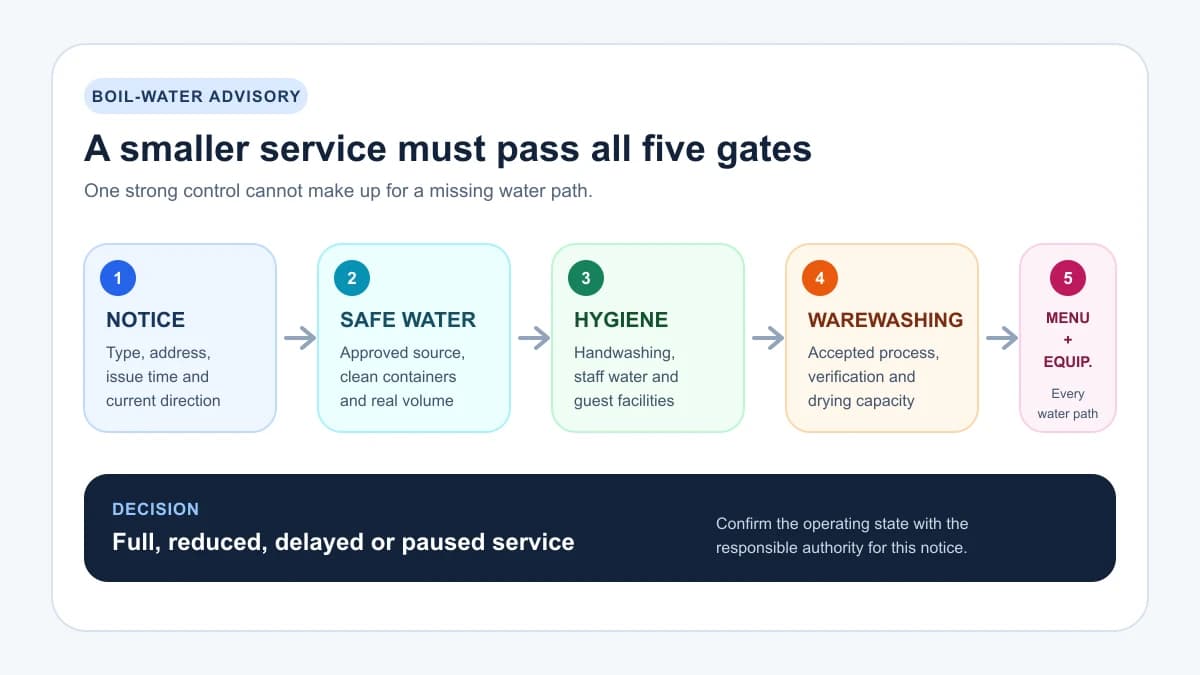
Use five gates before promising any service
| Gate | Evidence needed now | Failure response |
|---|---|---|
| Authority | Current notice, local food-premise directions, contact or escalation path | Pause the affected work while obtaining direction |
| Potable supply | Approved bottled, hauled or properly boiled water in enough clean containers | Remove the dependent item or service |
| Hand hygiene and washrooms | A method accepted under this notice, plus supplies and staff instructions | Do not handle food or admit guests into an unsupported setup |
| Warewashing and surfaces | An accepted machine or manual process, verification method, clean landing and drying capacity | Reduce volume or suspend service |
| Menu and equipment | Every retained item and water-fed appliance mapped to an allowed process | Close the item, station or operating channel |
Passing one gate does not compensate for failing another. Cases of bottled water do not fix an unapproved handwashing process. A high-temperature dish machine does not decide whether a cold beverage line is safe. A reduced menu is useful only when the remaining workflow passes all of the gates that still apply.
Do not turn bottled water into false capacity
Before keeping the full menu, build a short water ledger. List each surviving menu item or station, the safe-water source it needs, the container and handling step, expected service demand, and who replenishes it. Include cleanup and employee needs, not only recipe water. A plan that covers six pots of soup but not handwashing, sanitizer preparation or the next dish batch is not a service plan.
Use a conservative operating state: full service, reduced seating, takeout only, limited menu, delayed opening, or closed. Set the next review time. If safe-water demand, trained coverage or clean-ware inventory is uncertain, choose the smaller state while the qualified authority or inspector resolves the question.
Forum discussions often reduce the problem to “just boil water.” That phrase hides scald risk, cooling and storage, container sanitation, throughput, equipment lines and the difference between notice types. Treat it as demand language, not operating guidance.
Follow the 10:24 a.m. lunch decision
The fictional Halifax restaurant stops its ice machine, soda gun, produce sink and connected drink equipment. The manager marks the issue time and holds the ice, cut lettuce, cold sauce and morning beverages until the person responsible for food safety decides their disposition using the notice and Nova Scotia guidance. The team does not keep the salad menu because the lettuce looks normal.
Sealed drinks, packaged food and cooked items that can follow a verified safe-water process remain candidates, not automatic approvals. The manager maps handwashing, warewashing, washrooms and cleaning next. The restaurant has bottled water for drinking and some prep, but its alternative supply and clean-ware capacity cannot support the expected dine-in lunch.
The manager delays opening, contacts the appropriate provincial or local authority, and prepares a much smaller takeout menu that will be used only if the full control map is accepted for the situation. Scheduled employees receive a factual update and a next decision time. No one is told that lunch is cancelled or guaranteed before that decision is made.
Province examples are not interchangeable instructions
Nova Scotia keeps a current boil-water advisory list and publishes a food-safety document for water use during an advisory. Its commercial-establishment guidance addresses drinking water, produce, ready-to-eat ingredients, ice, beverage lines, warewashing and restart. Use the current provincial source and contact route for the restaurant, rather than copying one temperature from an old checklist into a new machine.
Québec published updated food-establishment instructions on June 18, 2026. They direct operators to stop affected water use for food preparation and conservation, close network-fed water and beverage equipment, provide alternative potable water, and follow specific cleaning, sanitizing and equipment conditions. Alberta’s July 2025 food-establishment guide gives a separate set of conditions under which a business may operate. These examples prove why the exact province and notice matter, not that one province’s method applies across Canada.
Restart by equipment path, not by announcement alone
Do not restart because a social post says the water is fine. Confirm that the issuing authority has rescinded or changed the notice for the restaurant’s address. Preserve that time and source. Then follow the authority and manufacturer instructions for faucets, filters, ice machines, beverage lines, coffee equipment, dish machines, water softeners and other connected devices.
Keep affected food disposition, flushing, cleaning, sanitizing, filter changes, equipment release and the first verified production batch as separate checks. New Brunswick and Nova Scotia guidance both call for water-connected equipment and lines to be flushed or sanitized as directed after an advisory. If the restart method or an earlier batch remains uncertain, keep it on hold and contact the responsible authority.
Record the staffing consequence, not the safety verdict
After the qualified food-safety owner chooses the operating state, Maxuod Shift can help a manager update role coverage, publish the changed shift, and retain actual start and end times for the payroll handoff. A delayed opening may need one manager for authority calls, a trained cleaning team, a receiver for alternate water and fewer service roles. A closure may still leave approved shutdown or restart work.
Keep safety facts in the restaurant’s approved incident record. The schedule note should contain only the operating instruction employees need, such as “opening decision at 11:30; do not begin food prep until the manager releases the station.” Maxuod Shift does not monitor water, approve a substitute supply, decide whether food is safe, authorize reopening, calculate final payroll, or provide legal advice.
Use the Restaurant Manager Incident Handbook to hand off the authority, food, equipment, guest and staffing records without collapsing them into one vague note.
The operating default
Stop the affected water paths first. Read the exact notice. Build a smaller service only from controls that the restaurant can prove and the responsible authority accepts. If potable supply, hygiene, warewashing, facilities or trained coverage fails, reduce or suspend service. When the notice ends, restart each connected process deliberately and preserve the evidence.
Review these sources and contacts before the next advisory, not while guests are waiting. The water plan should name the utility alert channel, public-health contact, alternate-water supplier, equipment shutdown points, food hold labels, communication owner and staff call tree. Recheck it whenever equipment, menu or authority guidance changes.
FAQ
Does a restaurant have to close automatically during a boil-water advisory?
Not under one universal Canada-wide rule. The restaurant must follow the exact notice and its provincial or local food-premise instructions. If it cannot maintain an accepted potable supply, hand hygiene, warewashing, facilities and a safe menu, it should reduce or suspend operations until those conditions are restored.
Can restaurant employees wash their hands with tap water during a boil-water notice?
Directions vary by notice type and jurisdiction. Some authorities permit a specified handwashing method during a boil-water advisory, while a do-not-use notice can prohibit tap-water contact. Follow the current notice and local food-safety authority rather than a generic internet instruction.
What food and drink should be held after the notice arrives?
Hold ice, beverages, ready-to-eat food and other products that may have used the affected water during the relevant time. Record when they were made and which water path was involved. The responsible authority or qualified food-safety owner should decide release, disposal and any recall action.
Can Maxuod Shift decide whether the restaurant stays open?
No. Maxuod Shift can record changed role coverage, schedule versions and actual hours after the operator makes the decision. It does not assess water or food, interpret an active advisory, authorize service or replace public-health guidance.
Official sources checked
Reviewed September 4, 2026
- Canadian Food Inspection Agency, water for use in food preparationCanada, for food businesses within the applicable federal scope
- Nova Scotia, Water Use During Boil Water AdvisoryNova Scotia
- Alberta Health Services, water use in a food establishment during a boil-water advisoryAlberta
- Québec.ca, avis concernant l’eau potable dans les établissements alimentairesQuébec
Written as an operator checklist, not legal or payroll advice. Confirm local rules before changing pay, holiday, or tip policies.
Related guides
Restaurant Freezer Power Outage: Protect Food Before You Rebuild the Shift
Use a restaurant outage checklist to keep doors closed, log time and temperature, isolate affected food, contact the right authority, and rebuild coverage.
Restaurant Shift Handoff Checklist: Pass the Exceptions
A restaurant shift handoff checklist for exceptions, owners, deadlines, actual-hour changes, and close-to-open decisions without a chat dump.
Your Certified Food Handler Calls Out. Can the Restaurant Still Open?
Compare food-handler certificate coverage across all 13 Canadian jurisdictions and decide what to verify before replacing a trained worker or opening a shift.
Build the schedule before the week gets loud
Maxuod Shift keeps employee availability, overtime risk, payroll estimates, and tip distribution in the same place for small restaurant teams.