
By Deeyoung MaLinkedInWebsiteAugust 23, 202613 min readRestaurant OperationsReviewed August 23, 2026
What the August 2026 U.S. Tariff Increase Could Cost Canadian Restaurants
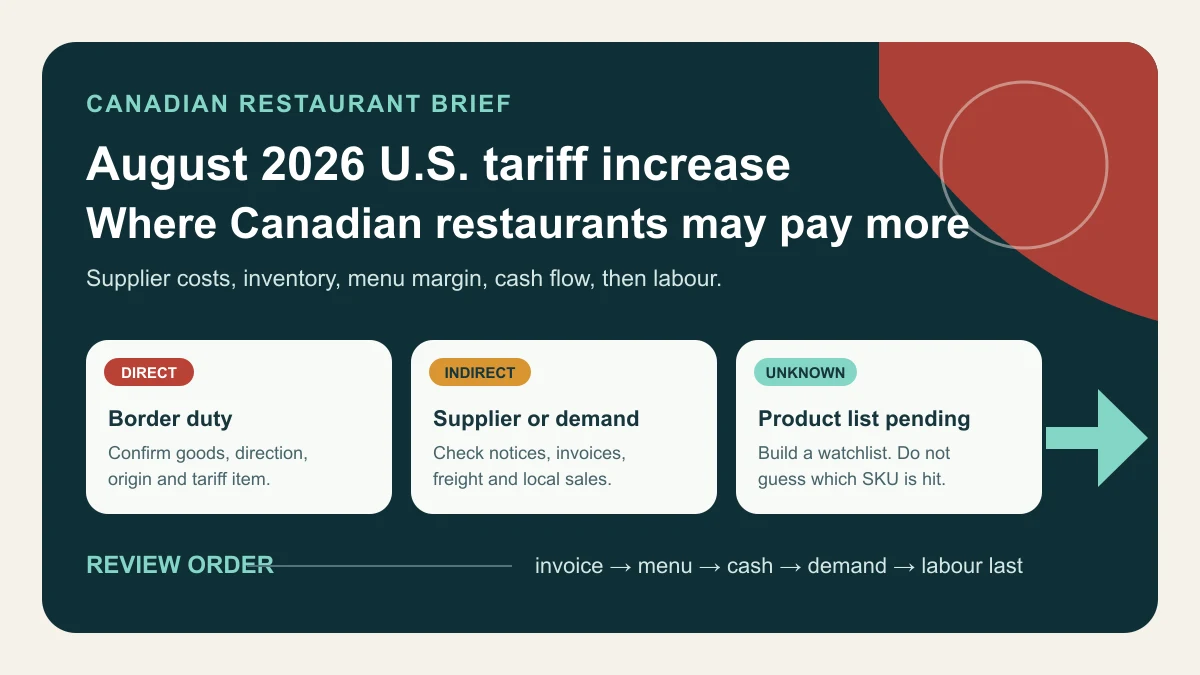
Review how the August 2026 U.S. tariff increase and Canada’s announced counter-tariffs could affect supplier costs, inventory, menus, cash flow, and labour.
Key takeaways
- The new U.S. duty is charged on covered Canadian goods entering the United States. It does not automatically add a tariff line to a Canadian restaurant invoice.
- Canada announced counter-tariffs for after Labour Day, but its product list, exemptions, and remission design were not yet published when this article was reviewed on August 23, 2026.
- Trace a cost from supplier notice to invoice, recipe or packaging use, menu contribution, demand, and cash flow before changing a menu price or schedule.
- Build a purchasing watchlist now, but buy ahead only after exposure is confirmed for the exact SKU and the item is high-turn, shelf-stable, safe to store, and affordable to carry.
- Labour is the final scenario lever. A tariff headline alone is not evidence that a restaurant should cut shifts, reduce opening hours, or remove required-role coverage.
The August tariff news creates two different questions for a small Canadian restaurant. The first is economic: which cost, if any, can be traced to the new measures? The second is operational: if a verified cost or demand change persists, what should the restaurant change without damaging the service that produces revenue?
Those questions have to stay in that order. The new U.S. duty is applied to covered Canadian goods entering the United States. It is not, by itself, a new tax on a Halifax café buying milk from a Canadian distributor or a Toronto restaurant ordering takeout containers. Canada has announced counter-tariffs that could affect Canadian import costs, but the product list was still pending when this article was reviewed on August 23, 2026.
Our default is therefore cost first, labour last. Preserve the invoices, supplier notices, menu contribution, sales mix, and cash-flow evidence before changing prices, purchasing, portions, opening hours, or the schedule. This is an operational briefing, not customs, legal, accounting, financial, pricing, or employment advice.
What changed on August 22, and what did not
The U.S. administration announced three Section 338 actions covering certain Canadian goods. Its original materials used August 19 as the effective date. Canada later confirmed a delay through the end of August 21, and the Associated Press reported that the 50% duties took effect on August 22 after negotiations broke down. AP estimated the measures cover about $20 billion, or roughly 5% of Canada’s annual exports to the United States.
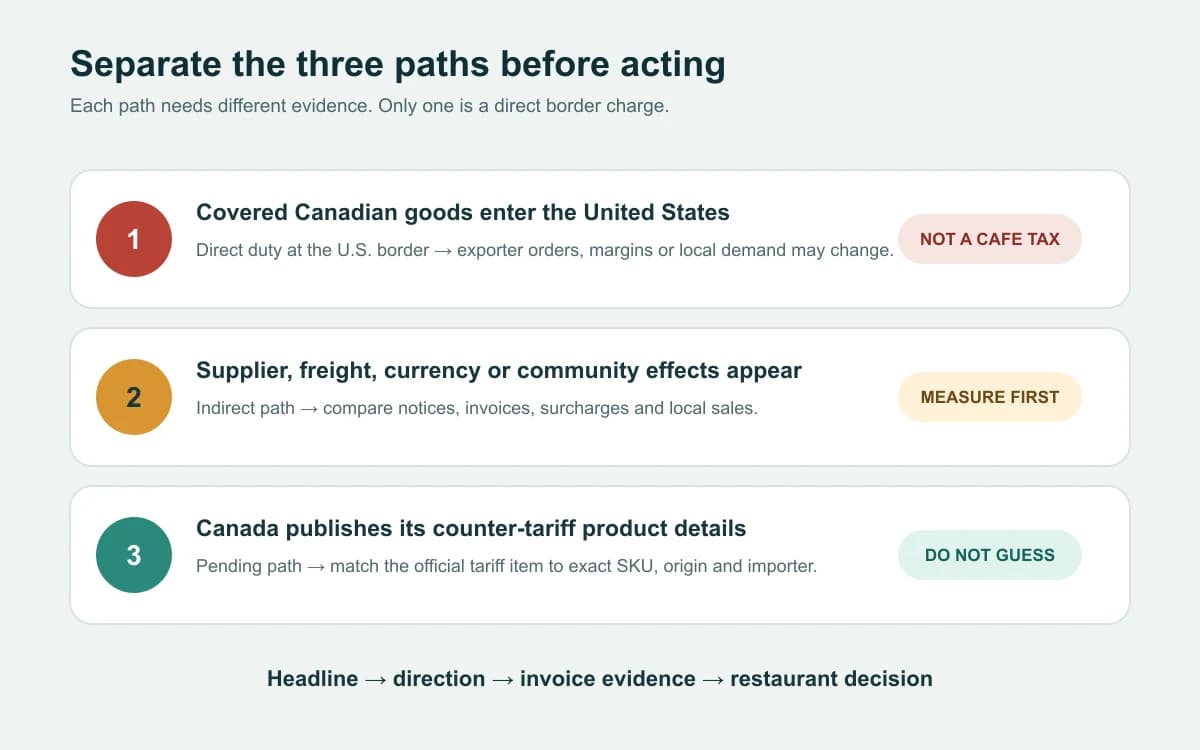
The direction of the duty matters. It is charged when covered Canadian goods enter the United States. Canadian exporters can face lost orders, lower margins, contract pressure, or redirected inventory, and communities tied to those exporters can face weaker demand. Those are real paths to monitor, but none proves that a domestic restaurant invoice increased because of this tariff.
Canada’s August 22 announcement said dollar-for-dollar counter-tariffs would begin the Tuesday after Labour Day and would be concentrated in sectors such as steel, dairy, appliances, agricultural equipment, pulp and paper, and electronics. It also said details would follow and acknowledged that the response could raise costs and reduce choice. Until the tariff lines, exclusions, and remission process are published, those sector names do not prove that a restaurant’s milk, cheese, paper cup, refrigerator part, or POS device is covered.
| Exposure path | Status on August 23 | What a restaurant can verify |
|---|---|---|
| Covered Canadian goods exported to the U.S. | Direct at the U.S. border | Whether the restaurant also exports a packaged product, or whether a major local customer base depends on an affected exporter |
| Canadian supplier, distributor, or community effects | Possible and indirect | Supplier notices, invoice changes, contract dates, local bookings, covers, sales mix, and event demand |
| New Canadian counter-tariffs on U.S. goods | Announced; product scope unknown | The official Canadian list when released, followed by the exact SKU, origin, importer, exception, and effective date |
The first cost question is: which line moved?
Start with the delivered cost, not the explanation attached to it. Pull the last four comparable supplier invoices and the current one. Match the same SKU, case size, grade, origin when available, delivery terms, credits, and surcharge treatment. A larger invoice can come from price, quantity, pack-size shrinkage, freight, fuel, currency, commodity movement, shortage substitution, or a tariff. More than one cause can be present.
Ask the supplier to identify the change in writing: affected SKU; old and new unit or case cost; effective date; origin; tariff or surcharge basis; contract clause; alternate pack or product; expected review date; and whether a credit or remission claim could later apply. A distributor’s general “tariff adjustment” label is a lead for the review, not proof that every product in the order carries the same exposure.
Then connect the invoice line to actual use. A case cost does not tell the restaurant what happened to a menu item until yield, trim, spoilage, portion, recipe quantity, packaging, and sales mix are included. Local sourcing can reduce some exposure, but it is not automatically available, equivalent, safer, or cheaper. Supplier approval, food-safety specifications, allergen records, capacity, lead time, and consistency still matter.
Build a cost-exposure watchlist before you build inventory
A restaurant can prepare before the final product list without pretending to know it. Export the last eight to twelve weeks of purchases and group spend into exposure buckets. The purpose is to know whom to call and which invoice lines to compare when the tariff details arrive. It is not a claim that every item in a bucket will be tariffed.
| Cost bucket to audit | Restaurant examples to locate | Evidence needed before acting |
|---|---|---|
| Dairy and other U.S.-origin food inputs | Cheese, butter, cream, specialty dairy, sauces, oils, nuts, produce, sweeteners, beverage bases, and processed ingredients | Exact SKU, country of origin, importer, HS tariff item, effective date, supplier notice, and approved substitute |
| Paper, pulp, plastic, and metal service supplies | Napkins, cups, cartons, takeout containers, foil, pans, cans, lids, labels, and cleaning consumables | Material specification, unit count, origin, existing inventory, alternative fit, food-contact approval, and delivered price |
| Equipment, electronics, and replacement parts | Refrigeration, dishwashing, cooking equipment, filters, smallwares, controls, POS hardware, printers, and compatible parts | Model compatibility, origin, importer, warranty, lead time, installed service life, repair advice, and whether a spare prevents a real single-point failure |
| Freight, brokerage, fuel, currency, and supplier pass-through | Delivery surcharges, customs or brokerage on direct imports, route charges, minimum-order changes, and contract adjustments | Contract clause, invoice reason code, start and end date, affected shipment, and whether the charge is temporary or recurring |
| Local demand exposure | Bookings or traffic tied to an affected exporter, plant, farm, port, distributor, event, or community employer | Actual reservations, covers, sales by daypart, cancellations, local operating notices, and comparable periods |
The federal announcement makes dairy, pulp and paper, steel, appliances, agricultural equipment, and electronics reasonable places to start the audit. It does not establish that all restaurant products made from or associated with those sectors are covered. Agricultural-equipment tariffs, for example, could affect a producer’s costs over time without placing a tariff on the tomatoes or beef a restaurant buys. That upstream effect has to appear in a quote, invoice, contract, or supplier explanation before it becomes a restaurant cost.
Add each watchlist item to one of four states: confirmed exposure, supplier review pending, indirect exposure only, or no evidence yet. “No evidence yet” is a valid result. It prevents a broad headline from becoming a purchasing decision.
Buy ahead only when the item passes six gates
A short inventory buffer can be rational when it protects a known high-turn input from a documented near-term change. It can also trap cash, create spoilage, exceed safe storage, complicate traceability, or leave the restaurant holding the wrong pack after a menu change. Use all six gates before placing an extra order.
- Exposure is confirmed: the exact SKU and origin match an official tariff item or a documented supplier charge; a sector headline is not enough.
- Usage is stable: the item has a repeatable weekly issue rate and is not dependent on one event, season, or uncertain menu forecast.
- Shelf life clears the buffer: the use-by or quality window extends beyond the planned drawdown with room for receiving variation.
- Storage stays controlled: the restaurant has approved dry, chilled, or frozen capacity without crowding airflow, blocking access, or weakening FIFO and traceability.
- Cash still works: the avoided cost is larger than financing, storage, insurance, shrinkage, and the value of cash tied up before sale.
- There is a stop date: the buyer records the normal weekly use, maximum extra quantity, review date, and condition that cancels the buy.
| Situation | Default decision | Safer preparation |
|---|---|---|
| Confirmed exposure, high-turn, shelf-stable, adequate space and cash | Model a modest, time-bounded buffer | Base quantity on normal usage and a written review date, not on the tariff percentage alone |
| Fresh dairy, produce, meat, seafood, or other perishable input | Do not stockpile by default | Confirm delivery cadence, approved alternates, menu substitution, and waste exposure |
| Unconfirmed food or packaging category | Monitor only | Request origin and tariff-line evidence, preserve quotes, and price an approved alternative |
| Long-lead replacement part for critical equipment | Do not buy generic parts speculatively | Ask the service technician whether a compatible spare addresses a documented single-point failure |
| Lower quote from a new supplier | Do not switch on price alone | Recheck licence, specification, allergen information, cold chain, recall contact, capacity, and trial acceptance |
For perishables, preparation usually means better information rather than more cases: confirm alternate origins and pack sizes, pre-approve substitutions, check lead times, reduce unexplained waste, and decide which menu item can pause if supply fails. For shelf-stable goods, compare the carrying cost with the documented increase. For equipment, prioritize preventive maintenance and a verified critical spare over a room full of speculative hardware.
The available evidence argues against one universal response
Statistics Canada’s second-quarter table provides the best current national operating context, but it predates this August escalation and covers accommodation and food services, a group broader than restaurants. In that group, 39.8% reported passing tariff-related cost increases to customers, 40.5% reported not passing them on, and 19.7% reported no tariff-related cost increase over the previous 12 months. The split is the finding: businesses did not experience or respond to the earlier pressure in one uniform way.
A second Statistics Canada table asked the same broad sector about expected 12-month effects. For U.S. tariffs on goods sold by Canadian businesses, 23.2% expected a major negative impact and 21.1% a minor negative impact. For Canadian tariffs on purchases from U.S. businesses, 24.9% expected a major negative impact and 23.6% a minor negative impact. These are expectations, not realized restaurant invoice costs, and substantial shares answered no impact or unknown.
A June 2026 Bank of Canada staff working paper supplies a useful counterweight to “a 25% tariff means a 25% shelf-price increase.” In a study of tariffed products at seven major Canadian retailers during an earlier counter-tariff episode, prices rose gradually and peaked at 6% after three months, about one-quarter pass-through of the 25% tariff. The authors found little spillover to untariffed substitutes in that study. That is evidence about one retail episode, not a forecast for wholesale food, restaurant menus, or Canada’s next tariff list.
Restaurants Canada’s August 22 update says the association is now focused on the scope and implementation of Canada’s response after earlier retaliatory measures created unintended operator costs. CFIB’s current tariff research shows serious loss expectations among affected small exporters. Both are useful exposure signals. Neither identifies the cost change at a particular restaurant or supports a staffing forecast.
| Source | What it supports | What it does not support |
|---|---|---|
| Statistics Canada, Q2 2026 | Earlier tariff costs and expectations varied across accommodation and food services | A universal restaurant increase, a cause for one invoice, or the impact of the new August measures |
| Bank of Canada staff study | Retail pass-through can be gradual and partial | A 6% forecast for restaurant suppliers or menu prices |
| Restaurants Canada | The industry association is warning government about unintended operator costs and remission design | A measured cost for an individual restaurant |
| CFIB exporter research | Affected small exporters reported serious revenue risk | The share of restaurants affected or a restaurant staffing forecast |
A fictional invoice shows why attribution comes before action
Consider a fictional independent restaurant comparing one week with a similar week four weeks earlier. Food and beverage delivered cost rises by $310, takeout packaging by $90, and delivery surcharges by $60. The total increase is $460. With $32,000 in weekly net sales, that equals 1.44% of sales. This is illustrative arithmetic, not a tariff estimate or benchmark.
The manager still cannot label the full $460 “tariff.” The food increase may be a commodity or pack-size change. The packaging increase may be tied to a U.S. origin, freight, exchange rate, or supplier repricing. The delivery surcharge may have nothing to do with a tariff. The manager needs a reason code and source note beside each change before choosing a response.
| Observed change | Evidence needed | Narrow response to model |
|---|---|---|
| $310 food and beverage increase | Same SKUs, quantities, pack sizes, yield, origin, supplier notice, credits | Quote the affected item, correct yield or waste, or model a targeted menu change only if contribution no longer holds |
| $90 packaging increase | Unit count, material/specification, origin, freight, substitute compatibility | Test an approved equivalent or change packaging use; do not swap without fit, food-contact, and service checks |
| $60 delivery surcharge | Contract, route, fuel/freight basis, temporary or recurring status | Consolidate deliveries or renegotiate only if inventory and receiving capacity can support it |
| $460 total increase | All of the above plus sales, cash flow, contribution and persistence | Choose the smallest reversible combination; do not apply a 1.44% menu increase by reflex |
The result of the six-gate test may be “do not buy more.” Perishable shelf life, storage capacity, food safety, working capital, insurance, and a policy reversal can turn a buy-before-prices-rise decision into waste. Supplier switching is not the default either. A new price is only one part of supplier qualification.
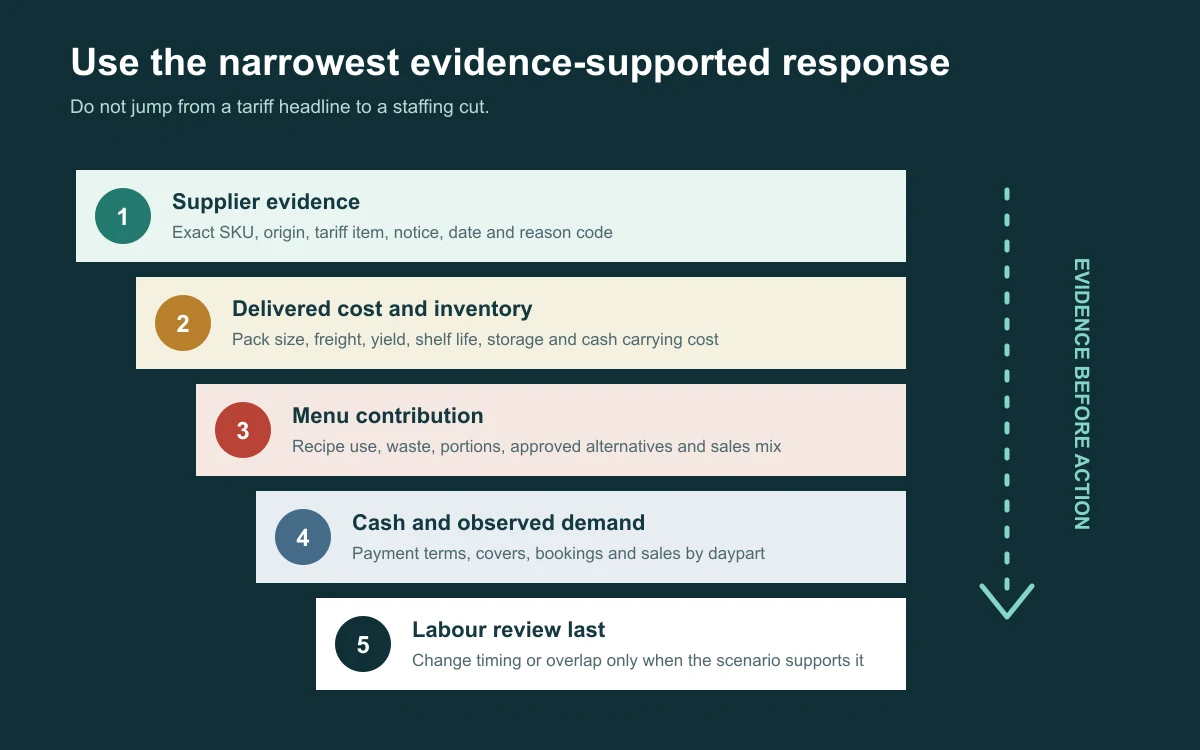
Price, menu, purchasing, and cash flow come before labour
After the invoice lines are classified, test the response in this order. First, correct avoidable purchasing or yield loss. Second, review menu contribution and sales mix: a high-volume item with a narrow margin needs different treatment from a low-volume item that already carries room. Third, test whether a targeted price, portion, specification, or menu placement change would protect contribution without breaking the guest promise. Fourth, check cash conversion, payment terms, inventory days, and the cost of carrying more stock.
Demand belongs in the same review. Tariffs on Canadian exports can affect a restaurant indirectly when an affected employer, port, manufacturer, farm, or supplier changes local hours, contracts, or employment. That path must be observed in bookings, covers, average check, takeout mix, events, and dayparts. A national trade headline cannot tell a neighbourhood restaurant whether Tuesday dinner will be quiet.
The safest immediate action is therefore a measurement change, not an operating cut: mark the affected invoice lines, preserve the source notice, set a review date, and compare equivalent periods. If the official Canadian list later confirms an affected input, the restaurant already has the baseline needed to measure the actual change.
Labour becomes relevant only when the operating evidence changes
Labour should enter the decision when one of two things is visible: actual demand moved by daypart, or the restaurant’s verified cost-and-margin scenario no longer supports the same service pattern. Even then, the first scheduling question is not “how many people can we remove?” It is “which overlap, prep window, handoff, or task can change without removing required skill and control?”
Keep the roles needed for opening, receiving, cooking, allergy communication, alcohol service, supervision, sanitation, and close. Compare planned and actual hours with sales by daypart. A slower Tuesday lunch may support a later start or shorter overlap. It does not prove that Friday dinner, weekend prep, or the closing team should be cut. If demand is unchanged, a food or packaging cost problem is not automatically solved by fewer employee hours.
Maxuod Shift supports this downstream review. A manager can compare scheduled and actual hours, see weekly totals, preserve the approved roster, and export hours for a payroll handoff. The restaurant labour cost percentage guide remains the owner for the labour calculation, and the restaurant labour cost calculator can model scheduled and actual scenarios.
Maxuod Shift does not read supplier invoices, classify goods, calculate customs duties, identify a tariffed SKU, forecast demand, price a menu, approve a supplier, run payroll, or decide an employment response. Keep purchasing evidence in the purchasing or accounting record and use the schedule only for the labour decision it actually supports.
Build the evidence packet now; wait for proof before changing the operation
- Freeze the baseline: save four comparable invoice periods, unit and case costs, pack sizes, credits, delivery charges, net sales, item mix, and actual hours.
- Build the watchlist: identify recurring food, beverage, packaging, equipment, parts, and delivery exposure without labelling unconfirmed items as tariffed.
- Code each change: supplier-confirmed tariff, freight, currency, commodity, shortage, contract, pack-size, quantity, unknown, or multiple causes.
- Map the menu exposure: connect the changed SKU to recipe yield, packaging use, item contribution, sales volume, and approved substitutes.
- Apply the buy-ahead gates: require confirmed exposure, stable use, adequate shelf life, controlled storage, positive cash economics, and a stop date.
- Model cash and guest effects: test payment terms, inventory days, waste risk, a targeted price or specification change, and what would invalidate the response.
- Review demand: use bookings, covers, sales by daypart, events, and local employer context; do not substitute national sentiment for the restaurant’s own pattern.
- Review labour last: compare scheduled and actual hours, then adjust only the avoidable timing or overlap supported by the demand scenario.
- Set the policy trigger: recheck the official Canadian product list, exemptions, remission rules, and effective date before naming an input as affected.
This article will need a policy recheck when Canada publishes those details. If the list shows little restaurant-input exposure, the right conclusion may be to monitor local demand and supplier notices rather than change purchasing or staffing. If it names material food, beverage, packaging, or equipment inputs, the evidence packet above turns the announcement into a SKU-level review instead of a panic response.
The default is deliberately conservative: measure first, protect cash and contribution second, and alter labour only when verified cost plus demand evidence makes the current pattern unsustainable. A future official list could change which inputs deserve attention. It will not change the need to trace the cost before acting.
FAQ
Do the new U.S. tariffs directly raise a Canadian restaurant’s supplier bill?
Not automatically. The U.S. duty applies to covered Canadian goods entering the United States and is paid at that border by the U.S. importer. A Canadian restaurant may still see indirect effects through suppliers, local demand, or a future Canadian counter-tariff, but each invoice change needs its own evidence.
Should a small restaurant raise menu prices because of the tariff announcement?
Not from the announcement alone. Compare equivalent supplier invoices, delivery and packaging charges, recipe yield, item contribution, sales mix, and demand. If a specific delivered cost is verified and persistent, test the narrowest response instead of applying one increase to the whole menu.
Should a restaurant reduce employee hours because tariffs may increase costs?
A tariff headline is not a demand forecast or staffing signal. Review costs and actual demand first. If sales later change by daypart, adjust avoidable overlap or prep timing while preserving the roles needed for safe service, food handling, supervision, and close.
Should a Canadian restaurant stock up before the counter-tariffs begin?
Not across the board. First confirm the exact SKU, origin, importer, tariff line, effective date, and supplier treatment. A modest buy-ahead can be modelled for a high-turn, shelf-stable item when storage, food safety, insurance, and cash capacity are adequate. Do not stockpile perishables, uncertain-demand items, or unfamiliar substitutes merely because their category appeared in a headline.
What should a restaurant ask a supplier about a price increase?
Ask which SKU changed, the old and new unit or case cost, effective date, origin, whether the change is a tariff, freight, commodity, currency, shortage, or contract adjustment, and whether a credit, substitute, alternate pack, or later review date exists.
What is still unknown about Canada’s response?
At the August 23, 2026 review cutoff, Canada had announced dollar-for-dollar counter-tariffs after Labour Day but had not published the product list, exemptions, or remission design in the cited announcement. Those details must be checked before naming any restaurant input as affected.
Official sources checked
Reviewed August 23, 2026
- White House: Section 338 tariffs on certain Canadian goodsUnited States; covered goods entering the United States
- Prime Minister of Canada: remarks on Canada-U.S. trade negotiationsCanada; announced response, with product details pending at review time
- Statistics Canada Table 33-10-1152-01: tariff cost increases passed to customersCanada; accommodation and food services, second quarter of 2026
- Statistics Canada Table 33-10-1148-01: expected tariff and trade-barrier impactCanada; accommodation and food services, second quarter of 2026
- Bank of Canada Staff Working Paper 2026-22: retail price impact of retaliatory tariffsCanada; research on an earlier retaliatory-tariff episode
Written as an operator checklist, not legal or payroll advice. Confirm local rules before changing pay, holiday, or tip policies.
Related guides
Restaurant Labour Cost Percentage in Canada: 2026 Cost Review
Calculate restaurant labour cost percentage, compare scheduled and actual inputs, and diagnose sales, coverage, overtime, or employer-cost changes.
How to Reduce Restaurant Labour Costs in Canada
Practical ways Canadian restaurants can lower labour cost without cutting service quality: demand-based scheduling, overtime control, prep timing, and payroll review.
Restaurant Labour Forecasting for Small Businesses
Build a restaurant labour forecast from demand signals, role-hours, base and flex coverage, then compare planned and actual hours with a worked example.
Build the schedule before the week gets loud
Maxuod Shift keeps employee availability, overtime risk, payroll estimates, and tip distribution in the same place for small restaurant teams.