
By Deeyoung MaLinkedInWebsiteSeptember 4, 202613 min readRestaurant OperationsReviewed September 4, 2026
Your Certified Food Handler Calls Out. Can the Restaurant Still Open?
Compare food-handler certificate coverage across all 13 Canadian jurisdictions and decide what to verify before replacing a trained worker or opening a shift.
Key takeaways
- Do not assume that any employee with kitchen experience can replace the person whose training covers the shift.
- The trigger differs by jurisdiction: some rules follow operator absence, some operating hours, some food preparation and service, and Alberta changes at six onsite food handlers.
- Québec offers two distinct training-coverage options, so an absent trained person does not produce the same answer for every establishment.
- Record the approved staffing change only after the operator or local authority confirms that the shift can proceed.
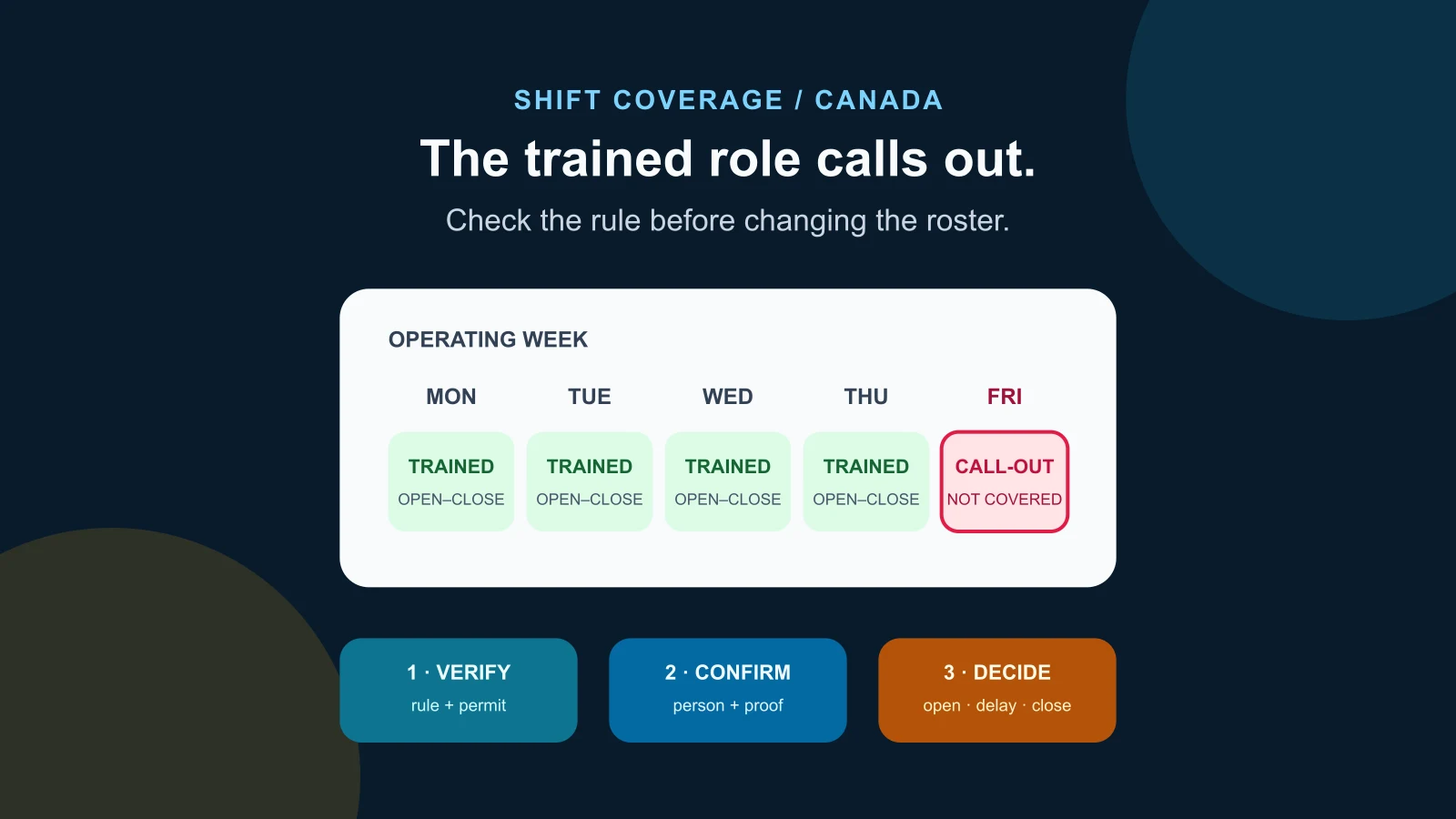
At 4:38 p.m., the only employee listed as the restaurant’s certified food handler calls out. Prep starts in 22 minutes. A supervisor can run the floor, the cooks know the menu, and the owner can answer the phone from home. None of that proves the food-safety training requirement is covered.
There is no single Canadian answer. Ontario ties trained coverage to every hour the food premise operates. Saskatchewan refers to the time food is prepared and served. Alberta changes its onsite rule when six or more food handlers, including serving staff, are working. Québec lets an establishment choose between two training-coverage options. The restaurant must check the rule, licence conditions and local public-health direction that apply to its actual operation.
This guide is a current routing aid, not permission to open. It does not certify an employee, interpret a permit, determine compliance, replace an inspector or provide legal or food-safety advice.
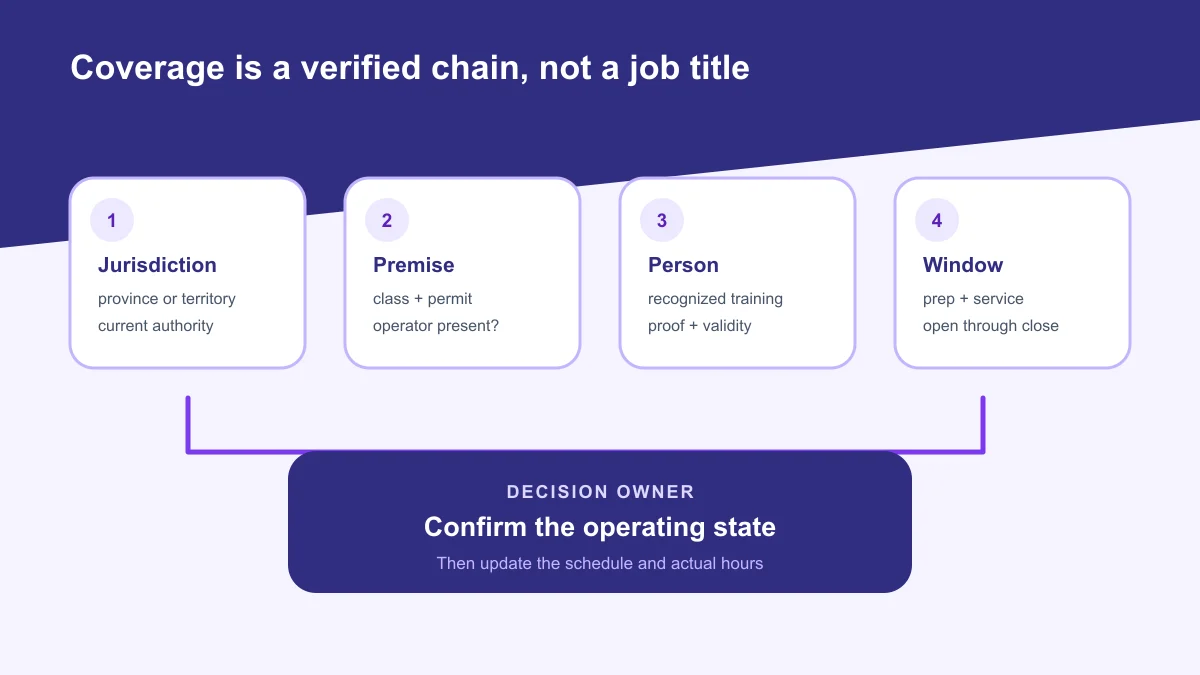
The answer changes with four facts, not the job title
Before calling replacements, write down four facts: the province or territory, the food-premise class or permit condition, whether the operator will be present, and how many people will handle or serve food during the affected period. “Manager,” “chef” and “senior server” do not prove that a recognized certificate is current.
| Fact | Why it can change the answer | Evidence to check |
|---|---|---|
| Jurisdiction | Coverage triggers and accepted courses differ | Current regulation and health-authority page |
| Premise or licence class | Some rules distinguish full preparation from limited or exempt operations | Permit, inspection record and local conditions |
| Operator presence | Several jurisdictions require a trained employee when the operator is absent | Who is physically present for the whole operating window |
| People and tasks onsite | Alberta uses a head-count threshold; other rules follow preparation, service or operating hours | Actual roster and work being performed |
A photograph of an old certificate in a group chat is not the final check. Confirm the holder, course recognition, validity or renewal rule, and whether proof must be available or posted. If any of those facts are uncertain, contact the applicable environmental health or public-health office before relying on the person as shift coverage.
Food-handler coverage across Canada: the manager’s routing table
The table summarizes the operating trigger visible in the official sources reviewed on September 4, 2026. It is deliberately shorter than the source. Exemptions, permit conditions, local orders and the type of food operation can change the result.
| Jurisdiction | Current coverage route to verify | Call-out implication |
|---|---|---|
| Alberta | At least one person in care and control certified; with 6+ food handlers onsite, a certified person must be at the facility | Count serving staff and confirm who is onsite |
| British Columbia | Operator holds FOODSAFE or equivalent; when absent, at least one certified employee is present | Operator presence can change the replacement need |
| Manitoba | Current Manitoba Health page distinguishes fewer than 5 handlers from more than 5; Winnipeg also has a person-in-charge bylaw | Confirm head count and local rule |
| New Brunswick | Class 4 premises: manager and at least one certified person present at all times in the food-preparation area | Check the licence class and prep-area coverage |
| Newfoundland and Labrador | For covered commercial preparation premises, at least one currently trained employee present while operating | A general supervisor is not a substitute without accepted training |
| Nova Scotia | Operator trained; if absent, a trained member of personnel is present | Verify operator presence and recognized training |
| Ontario | At least one trained food handler or supervisor onsite during every operating hour | Cover the entire operating window, not only the rush |
| Prince Edward Island | Licence holder trained and trained coverage during operating hours; current page also states five-year renewal | Check both presence and certificate validity |
| Québec | Designated trained manager plus one of two establishment-wide coverage options | Identify which option the establishment actually uses |
| Saskatchewan | Unless exempted in writing, an approved-course holder works whenever food is prepared and served | Match the replacement to the preparation-and-service window |
| Northwest Territories | Territorial page says certified trained food handlers are required in every food premise on every shift | Treat each shift as a separate coverage check |
| Nunavut | Operator certified within the previous five years; if absent, at least one currently certified employee present | Confirm presence and the five-year window |
| Yukon | Use the food-business permit route and Environmental Health Services to confirm the premise-specific training condition | Do not infer permission from the absence of a simple public one-line rule |
Québec is the reason a single national yes-or-no answer fails
Québec requires the operator to designate a person responsible for controlling food hygiene and safety who holds manager training. The establishment then chooses one of two paths. Under the presence path, that responsible person is present during staff activity hours; otherwise at least one employee with manager or food-handler training must be present. Under the percentage path, at least 10% of the people assigned to food preparation, including cleaning and sanitizing food-contact equipment, hold manager or food-handler training; continuous presence is not the same condition under that option.
That does not mean a Québec restaurant can switch options informally after a call-out. The operator needs to know which option governs the establishment, how the percentage is calculated and documented, and whether another permit or inspector condition applies. The French companion guide handles this scenario in Canadian French and routes readers directly to Québec and New Brunswick sources.
Run a ten-minute call-out check before promising service
- Hold the opening promise. Tell the team that the operating decision is pending; do not ask anyone to start regulated work to “save time.”
- Confirm the exact gap. Record the absent person, certificate or training type, expiry if applicable, planned times and covered task.
- Check the official trigger. Read the current regulation, health-authority page, permit and latest inspection direction for the premise.
- Find a qualified replacement. Verify the person and proof before assigning the coverage; do not convert an employee’s private certificate into a public schedule note.
- Escalate uncertainty. Call the environmental health or public-health contact when recognition, exemption, local rule or coverage time is unclear.
- Publish only the approved state. Open, delay, reduce the operation or close based on that decision, then record actual hours separately.
Do not use understaffing as a reason to lower the requirement. Also do not add a trained person only on paper while that person works offsite, leaves before close or is assigned somewhere they cannot provide the coverage the rule requires.
Worked example: Alberta changes at the sixth person
A fictional Calgary café scheduled one certified shift lead, two baristas, one cook and one counter employee. With five food handlers onsite, Alberta Health Services says the certified person may be offsite, although at least one person in care and control of the facility must be certified. The manager still checks the permit and inspector direction rather than treating five as a universal exemption.
At 5:30 p.m., a sixth worker arrives for the dinner overlap. The AHS rule now says a certified person must be at the facility because six or more food handlers are working onsite, and serving staff count. If the qualified replacement cannot arrive until 6:15, the manager cannot erase the 45-minute gap by renaming a server “lead.” The operating plan must change or the responsible authority must confirm another lawful arrangement.
This example shows why a weekly schedule should include the approved coverage role and its time window, not a permanent compliance badge. Head count and actual attendance can change during the shift.
Build redundancy without exposing certificate details
Maintain a restricted training register outside the public schedule: employee name, recognized course, proof location, issue or expiry information where relevant, jurisdiction, premise, and the manager who verified it. Set a review date before expiry. The weekly roster only needs the operational role or a neutral coverage marker that your policy defines.
For every opening, closing and overlap period, identify a primary and backup person. Test vacations, school availability, sick calls and split shifts. Newfoundland and Labrador’s own guidance notes that having several trained employees is practical for shift and absence coverage. That is resilience advice, not permission to ignore the requirement when the named person is missing.
Where Maxuod Shift fits—and where it stops
After the operator confirms who may cover the work, Maxuod Shift can place the approved role on the weekly schedule, show the time window, publish the replacement, and retain actual start and end times for the handoff. The restaurant call-out guide helps separate acknowledgement, coverage and follow-up; the shift handoff checklist keeps an unresolved inspection or training question with a named owner.
Maxuod Shift does not validate certificates, store an authoritative training record, decide whether a course is accepted, interpret a permit, count people under a legal definition, authorize food preparation or guarantee compliance. Never place certificate numbers, birth dates or other unnecessary personal information in a shared schedule note.
The operating default
When the trained person calls out, pause the promise, identify the actual provincial or territorial trigger, verify the replacement and proof, and ask the responsible authority when anything is unclear. Build coverage around the whole regulated window, not only the busiest hour. Then publish the schedule change and preserve actual hours without turning the schedule into the compliance decision.
Recheck the linked official sources before using this guide. Training programs, local conditions, licence classes and regulations can change after the September 4, 2026 review date.
FAQ
Does every Canadian restaurant need a certified food handler on every shift?
Not under one uniform national rule. Several jurisdictions require trained coverage while the premise operates or while food is prepared and served, but Alberta has an onsite head-count threshold and Québec provides two coverage options. Check the current rule, premise class, permit and local authority.
Can a manager without a food-handler certificate cover the call-out?
A management title alone is not proof. Whether the manager can cover depends on the jurisdiction, recognized training, current validity, operator presence, premise class and the tasks or operating hours involved.
Should the certificate be attached to the employee schedule?
Usually the shared schedule should show only the approved coverage role and time. Keep certificate proof and personal information in a restricted training record that the authorized manager can produce when required.
Can Maxuod Shift tell a restaurant whether the shift is compliant?
No. It can schedule a role and record the approved replacement and actual hours after a manager makes the decision. It does not verify training, interpret regulations or authorize restaurant operations.
Official sources checked
Reviewed September 4, 2026
- Alberta Health Services, Food Safety Training Requirements in AlbertaAlberta
- British Columbia, Food Premises Regulation, section 10British Columbia
- Manitoba Health, Certified Food Handler Training ProgramManitoba
- New Brunswick, food safety training and certificationNew Brunswick
- Newfoundland and Labrador, Food Safety TrainingNewfoundland and Labrador
- Nova Scotia, Food Safety Regulations, section 28Nova Scotia
- Northwest Territories, Food Safety TrainingNorthwest Territories
- Nunavut, Food Safety Tool Kit for Food PremisesNunavut
- Ontario, Food Premises Regulation, section 32Ontario
- Prince Edward Island, Food Safety TrainingPrince Edward Island
- Québec, types de formation et inscription en hygiène et salubrité alimentairesQuébec
- Saskatchewan, Food Safety Regulations, section 26Saskatchewan
- Yukon, Open a food businessYukon
Written as an operator checklist, not legal or payroll advice. Confirm local rules before changing pay, holiday, or tip policies.
Related guides
How to Build a Restaurant Backup Coverage List
Build a restaurant backup coverage list by role, availability, response window, and weekly hours, then use it when an employee calls out.
Restaurant Employee Leaves Mid-Shift: Stabilize the Service First
Protect safety, reset role coverage, record actual hours, and follow up without treating one mid-shift departure as automatic resignation or misconduct.
Restaurant Shift Handoff Checklist: Pass the Exceptions
A restaurant shift handoff checklist for exceptions, owners, deadlines, actual-hour changes, and close-to-open decisions without a chat dump.
Build the schedule before the week gets loud
Maxuod Shift keeps employee availability, overtime risk, payroll estimates, and tip distribution in the same place for small restaurant teams.