
By Deeyoung MaLinkedInWebsiteJuly 17, 202610 min readScheduling OperationsReviewed July 17, 2026
Rotating Shift Schedule: Fixed, Partial, or Full?
Compare fixed, partial, and full rotating shift schedules, inspect a two-cycle example, and test coverage, fatigue, fairness, and provincial rules.
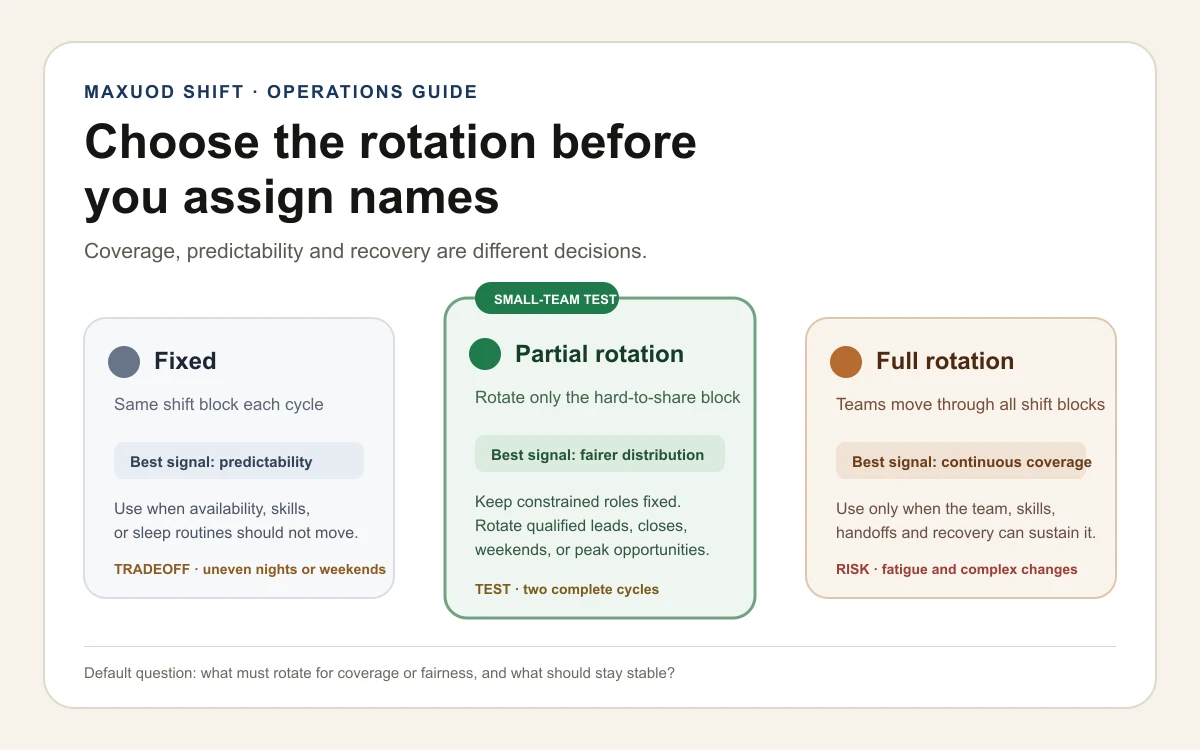
A rotating shift schedule is useful only when a time block needs to move. If the same employees can cover the same hours every cycle without concentrating every close, night, weekend, or high-value shift on one group, a fixed schedule may be the better answer.
Small teams have three credible choices: keep shifts fixed, rotate only the hard-to-share block, or rotate whole teams through day, evening, and night work. My default is the middle option. A partial rotation can distribute closes or weekends without forcing every employee to rebuild sleep, childcare, school, or second-job routines.
This guide compares those choices, follows one restaurant through a two-cycle test, and shows what to record before the pattern becomes policy. If you already know which pattern you need, use the editable 12-hour, 8-hour 24/7, alternating-weekend, or night-shift schedule template instead.
A rotation changes time blocks, not just names
The Canadian Centre for Occupational Health and Safety defines rotational shiftwork as shifts that change according to a set schedule. The operation may run continuously or for two or three shifts per day, and employees take turns working the shifts in that system.
That definition separates a rotating work schedule from ordinary weekly editing. Moving Ava from Tuesday to Wednesday is a schedule change. Moving Team A from day work to evening work after a defined cycle is a rotation. Alternating who owns weekends or closing lead duties is a partial rotation.
The distinction matters because each choice creates a different constraint. Fixed schedules concentrate some duties but preserve routines. Full rotations share the time blocks but increase change and handoff complexity. Partial rotations ask a narrower question: which unpopular or valuable block can move without destabilizing the rest of the roster?
The first decision is fixed, partial, or full
Do not begin by choosing a famous pattern. Begin with the operating reason for rotation. Continuous production, 24/7 service, fair weekend distribution, cross-training, and fair access to tip-heavy shifts are different problems and may need different schedules.
| Choice | Good fit | Warning sign | First test |
|---|---|---|---|
| Fixed shifts | Stable operating hours, specialized roles, strong employee time preferences, or people who need predictable sleep and family routines. | The same people carry every close, night, weekend, or weaker earning period. | Audit four weeks for unfair concentration before changing the pattern. |
| Partial rotation | A small team needs to share weekends, closing lead duty, peak shifts, or another specific burden. | The rotating duty requires a skill that only one employee has, or a change conflicts with approved availability. | Rotate one qualified responsibility for two complete cycles. |
| Full rotation | Extended or continuous coverage requires stable teams to move through defined day, evening, or night blocks. | Frequent exceptions, weak handoffs, insufficient recovery, or employees who cannot sustain changing time blocks. | Model the full cycle, required roles, rest, and absence cover before publishing. |
A pattern is not fair merely because everyone moves. Fairness also depends on notice, employee constraints, workload, earnings opportunity, recovery, and whether qualified people are present on every shift.
A small restaurant can rotate the hard block first
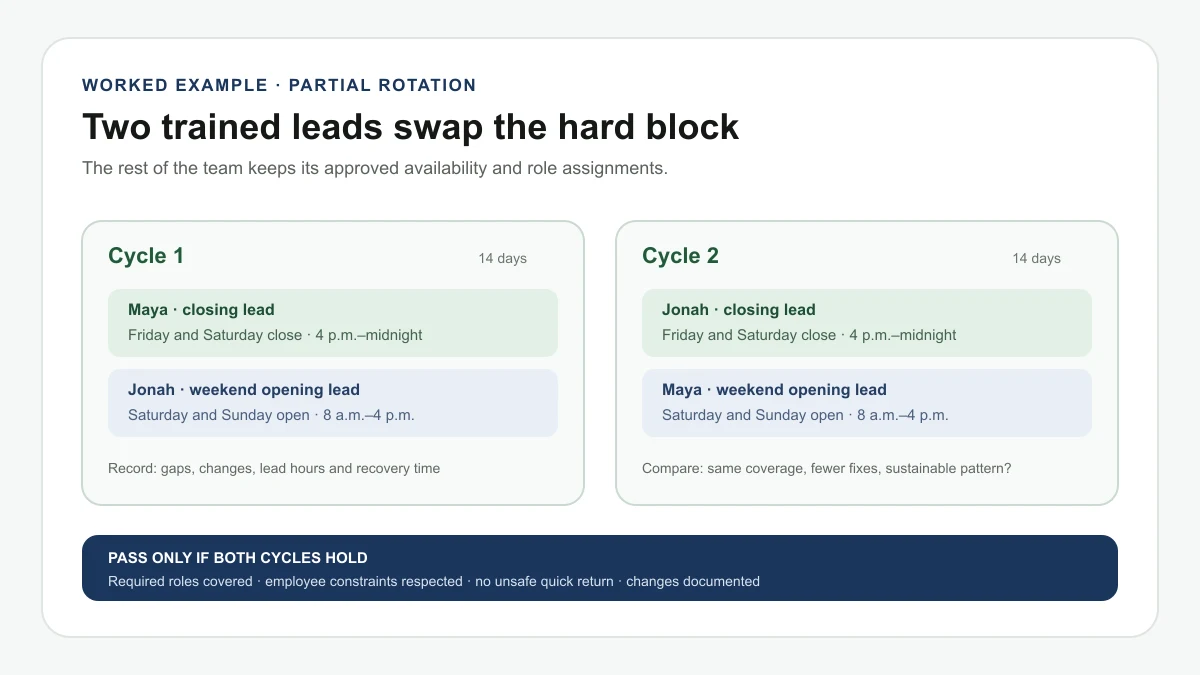
Consider a restaurant with two trained leads, Maya and Jonah. Both can open and close, but the Friday and Saturday close is harder to share. Other employees have approved availability and role assignments that do not need to move.
For the first 14-day cycle, Maya owns the two late closes and Jonah owns the weekend openings. In the second cycle, they swap. The restaurant has tested a shift rotation schedule without moving the entire service and kitchen team between early and late work.
This is an illustrative schedule, not a claim that every restaurant should use two-week rotations. The cycle works only if each lead is qualified, the rest between assignments is reasonable, every required role remains covered, and both employees can accept the changed time block.
Coverage has to pass before fairness
A roster can distribute weekends evenly and still fail the operation. Count required roles by time block before counting employees. A six-person dinner shift is not covered if no one can approve refunds, close cash, run the pass, or complete the required safety task.
Use a small coverage ledger for every block that rotates:
| Review field | Question | Pass signal |
|---|---|---|
| Required roles | Which skills or authorities must be present from open through handoff and close? | Every block has a named qualified owner, not only enough bodies. |
| Handoff | What must the outgoing shift transfer to the incoming shift? | There is scheduled overlap or a written handoff for cash, stock, incidents, and unfinished work. |
| Absence cover | Who can cover the rotating role if the assigned employee calls out? | A qualified backup exists without creating another uncovered role. |
| Weekly hours | What does the rotation do to each person's full week? | Planned totals and exceptions are reviewed before the schedule is published. |
This is where role-based planning improves on a simple rotating shift schedule example. The pattern describes who moves. The coverage ledger proves whether the work can still happen.
Fatigue changes the design, especially around nights
Rotation is not automatically healthier than fixed work. CCOHS notes that changing schedules, night work, and disrupted circadian rhythms can affect sleep, fatigue, family life, and safety. It also says the best rotation period is disputed because people and work conditions differ.
CCOHS recommends considering forward rotation, moving from day to afternoon to night, and allowing more recovery after sets of night shifts. Transport Canada's fatigue guidance also describes forward rotation as preferable to backward rotation. A Cochrane evidence review, however, says the comparative evidence for schedule changes is limited and very uncertain.
The practical conclusion is bounded: forward movement is a reasonable risk-control default when a rotation must change time blocks, but it is not a health guarantee. Avoid quick returns, examine the length and demands of each shift, collect employee input, and review the pattern with an occupational-health professional when the work is safety-critical or health concerns are present.
If overnight work can stay with employees who prefer and can sustain a fixed night schedule, compare that option with rotation. The night-shift template shows a fixed-night example and explains the current cross-midnight entry boundary in Maxuod Shift.
Canada does not have one universal rotation rule
A rotating schedule does not override employment standards. Overtime, weekly rest, meal breaks, scheduling notice, young-worker limits, collective agreements, and sector rules differ by jurisdiction and employee situation. Check the province or territory where the work occurs before treating a pattern as publishable.
For a Nova Scotia example, the province's current Breaks and Period of Rest guidance says that under normal circumstances employees receive at least 24 consecutive hours of rest in every seven days. It also says employees are entitled to an unbroken half-hour break so they do not work more than five consecutive hours without a break, subject to stated exceptions and exclusions.
That does not create a national template. Use the Canada payroll reference hub and meal-break comparison to reach the current official source for the applicable jurisdiction. Keep a review note when classification, an exception, a collective agreement, or actual hours could change the result.
Run two cycles and keep a decision ledger
One clean week does not prove that a rotating work schedule holds. It may miss the second handoff, the return to nights, a recurring weekend conflict, or the employee who ends up carrying extra changes. Test at least two complete cycles before making the pattern the default.
| Signal | Record each cycle | Fail condition |
|---|---|---|
| Coverage | Unfilled blocks, missing roles, and emergency extensions | A required role is repeatedly uncovered or covered only by overtime |
| Stability | Changes after publication and the reason for each change | The cycle needs repeated manual exceptions to survive |
| Recovery | Quick returns, consecutive nights, and rest after night blocks | The pattern depends on compressed recovery or recurring fatigue concerns |
| Fairness | Closes, nights, weekends, peak shifts, and employee constraints | The burden moved in name but remains concentrated in practice |
| Hours | Scheduled and actual hours by employee | Actual work repeatedly exceeds the planned cycle or triggers unresolved pay review |
| Team signal | Specific conflicts, handoff failures, and preference changes | The same issue returns in both cycles without a workable adjustment |
Pass the test only if both cycles cover the work, respect the team's real constraints, and require fewer exceptions than the pattern they replace. Otherwise, return to fixed shifts or reduce the scope of the rotation.
What Maxuod Shift can record, and what it cannot decide
Maxuod Shift helps turn the approved pattern into a reviewable week. A manager can assign employees and roles, inspect weekly hour totals, download a PDF, and keep the current schedule in one place. A free account supports saved employees and weeks, actual-hour review, tip workflows, wage estimates, CSV/XLSX exports, and province-aware review prompts within the current Free limits.
The product is not an automatic rotation generator. It does not decide whether a fixed, partial, DuPont, Pitman, or other pattern is safe or legal for a specific team. A continuous shift shorter than 24 hours can now use the Next day end-date option. The continuation remains one source record; actual elapsed time, provincial workday allocation and affected overnight premium amounts still require separate review.
The Maxuod contribution is the operating handoff: choose the pattern with the resource table, enter the approved week in the free shift schedule maker, compare planned and actual hours, keep exception notes, and review the provincial prompts before payroll. The manager still owns coverage and employee communication. Payroll, health-and-safety specialists, or legal advisers own the decisions that require their expertise.
For the entry itself, follow how to enter a restaurant closing shift after midnight. It shows one Next day assignment, the continuation and the separate actual-time review; it does not select a rotation.
The best pattern is the smallest one that solves the problem
Use fixed shifts when predictability and specialized availability matter more than sharing every time block. Use a partial rotation when one burden or opportunity needs fairer distribution. Use a full rotation only when extended coverage requires teams to move and the full cycle survives coverage, handoff, recovery, and jurisdiction checks.
For most small restaurants and hourly teams, start by rotating one qualified responsibility for two cycles. Measure gaps, changes, hours, recovery, and employee constraints. Expand the rotation only if the smaller test holds.
When the decision is made, build the next real week in the online shift scheduler or choose the exact schedule pattern resource that matches your coverage model.
FAQ
What is a rotating shift schedule?
A rotating shift schedule moves employees or teams through different time blocks according to a repeating cycle. A partial rotation moves only a defined responsibility such as closing lead duty or weekends, while a full rotation moves teams through day, evening, or night shifts.
Are fixed shifts or rotating shifts better for a small team?
Fixed shifts are usually better for predictability, specialized roles, and firm availability constraints. A partial rotation can be better when one burden or earning opportunity needs fairer distribution. Full rotation fits only when extended coverage requires it and the team can sustain the cycle.
What is a forward rotating shift?
A forward rotation moves from an earlier to a later time block, such as day to afternoon to night. Canadian occupational-health guidance recommends considering forward rotation, but research comparisons remain uncertain, so it should be treated as a risk-control default rather than a health guarantee.
How long should I test a rotating work schedule?
Test at least two complete cycles. Record role coverage, post-publication changes, quick returns, consecutive nights, scheduled versus actual hours, distribution of difficult shifts, and specific employee conflicts before adopting the pattern.
Can Maxuod Shift generate a rotating schedule automatically?
No. Maxuod Shift is a weekly scheduling and review tool, not an automatic rotation generator. Use the pattern resources to choose a cycle, then enter and review the approved week in the scheduler. A shift shorter than 24 hours can cross midnight in one entry using Next day. Provincial pay allocation, actual attendance and daylight-saving changes still require separate review.
Written as an operator checklist, not legal or payroll advice. Confirm local rules before changing pay, holiday, or tip policies.
Related guides
How to Make a Shift Schedule: A 7-Step Small-Team Workflow
Learn how to make a shift schedule in seven practical steps, then choose a free online shift schedule maker for weekly or monthly planning.
Free Shift Schedule Templates: Blank PDF Download
Download a blank shift schedule template PDF for weekly planning, then use a free Maxuod Shift account when you need saved schedules and PDF, CSV, or XLSX exports.
Weekly Restaurant Schedule Review: A 20-Minute Walkthrough
Review a restaurant schedule in 20 minutes with a worked walkthrough for coverage, availability, fairness, hours, backups, and payroll handoff.
Build the schedule before the week gets loud
Maxuod Shift keeps employee availability, overtime risk, payroll estimates, and tip distribution in the same place for small restaurant teams.