
By Deeyoung MaLinkedInWebsiteJuly 6, 202611 min readScheduling OperationsReviewed July 29, 2026
Time Management for Restaurant Shift Managers: A Weekly System
A weekly time-management system for restaurant shift managers: protect planning blocks, manage interruptions, delegate coverage, and close the week cleanly.

Planning and time management sounds like office language until you are the person trying to build next week's restaurant schedule while the espresso machine is down, two people have new availability, and Friday dinner is already short.
For a Canadian shift manager, planning and time management means turning the week into a rhythm: collect the facts early, decide what matters first, protect time to build the schedule, leave room for the rush, and review the week before payroll handoff. It is not about filling every minute. It is about making the important work visible before service starts making decisions for you.
This guide is an operations checklist, not legal, payroll, or tax advice. If a holiday, overtime, break, wage, tip, or payroll question appears, mark it for review and confirm the current official source for the province where the employee works.
Quick answer: planning and time management for shift managers
Planning is deciding what the week needs before you start assigning names. Time management is protecting enough focused time to make those decisions, then keeping the daily interruptions from taking over the whole schedule.
In a restaurant, cafe, food truck, bakery, or small retail team, the manager's planning system should answer five questions: what demand is coming, which roles must be covered, who is available, which risks need a backup, and what notes must travel to payroll or the next manager.
A generic productivity system can help, but only after it is translated into shift work. The Eisenhower Matrix becomes a way to separate call-outs from long-term training. Time blocking becomes a protected weekly schedule-building window. Pomodoro becomes useful for admin blocks, not during the lunch rush. A weekly review becomes the bridge between actual hours, tip pool notes, labour cost, and next week's draft.
Protect three kinds of manager time
Restaurant managers do not have one kind of workday. They need planning time away from service, presence during service, and people time for coaching, training, and difficult conversations. If every block is treated as interchangeable, the loudest task consumes all three.
| Manager time | Protect it for | Common leak | Weekly guardrail |
|---|---|---|---|
| Planning time | Availability, coverage, the draft schedule, hour totals, backups, and handoff notes | Messages and small edits split the work into ten fragments | Use one named drafting block and one review block |
| Service time | Guest flow, staff support, food safety, decisions, and recovery | Admin work follows the manager onto the floor | Move non-urgent approvals to a written after-service list |
| People time | Feedback, training, cross-training, check-ins, and clear expectations | Reliable employees receive more work but no development time | Schedule one specific coaching or cross-training action each week |
A manager can still be interrupted. The guardrail decides which work resumes after the interruption instead of letting the interruption rewrite the entire day.
Start with a one-week time audit
BDC advises business owners to notice where time really goes before trying to fix the calendar. For shift managers, that means tracking manager time by operating bucket for one normal week. Do not make it fancy. A note on your phone is enough.
The useful question is not "am I busy?" You already are. The useful question is which work keeps repeating because the plan was missing.
| Time bucket | What to track | What it may reveal |
|---|---|---|
| Schedule building | Drafting, editing, checking coverage, publishing. | The schedule is happening too late or in too many small pieces. |
| Availability chasing | Texts, verbal notes, late requests, repeated corrections. | The availability deadline is not clear enough. |
| Floor interruption | Supplier issues, guest problems, equipment, missing staff. | Buffers and backup roles are not visible before service. |
| Admin and handoff | Actual hours, tip notes, manager notes, export prep. | Payroll cleanup is being pushed to the end of the week. |
| People development | Training, cross-training, hard conversations, feedback. | Important work is losing to urgent work every week. |
Run the audit once, then look for the biggest leak. If availability chasing eats two hours every week, fix the availability process before adding another productivity trick.
Use the Eisenhower Matrix for shift work
The Eisenhower Matrix separates urgent work from important work. For a shift manager, the trick is to put real restaurant examples into the boxes.
| Priority box | Shift-manager example | Action |
|---|---|---|
| Urgent and important | A line cook calls out before Friday dinner. | Act now, record the change, and check hour impact later. |
| Important, not urgent | Cross-training one server to cover host and takeout. | Schedule it before the next busy period. |
| Urgent, not important | A low-risk message interrupts the schedule draft. | Batch replies unless it changes coverage. |
| Neither | Reformatting a spreadsheet nobody reads. | Drop it, simplify it, or move it outside schedule time. |
This matters because restaurant managers often reward whatever is loudest. A better system protects the important-but-not-urgent work: training backups, cleaning up availability, checking weekly hour totals, and writing clear handoff notes.
Block the week before it blocks you
Time blocking works best when it follows the restaurant week. Do not block a perfect calendar that ignores service reality. Block the moments when decisions need to happen.
| Block | Manager work | Why it helps |
|---|---|---|
| Monday closeout | Review actual hours, late stays, early cuts, tip notes, and handoff issues. | The next schedule starts from what really happened. |
| Tuesday availability | Send reminder, collect changes, close the normal availability window. | Fewer Thursday rebuilds. |
| Wednesday draft | Build coverage by daypart before assigning final names. | Demand drives the schedule instead of habit. |
| Thursday review | Check coverage gaps, hour totals, holiday notes, and backup list. | Problems are still fixable before publish. |
| Friday publish and prep | Publish the schedule, confirm rush coverage, and name first backups. | The team enters the weekend with less guesswork. |
BDC's day-organization guidance also recommends leaving buffer time instead of packing the calendar to the edge. That is especially true in restaurants. A schedule with no slack turns every normal call-out, patio change, supplier delay, or equipment issue into a crisis.
Canada.ca's public holiday list is useful as an early calendar signal for weeks like Canada Day, Labour Day, or the August civic-holiday period. Treat it as a planning flag, not a payroll formula. The manager's job is to mark the week early and send the right questions to payroll review.
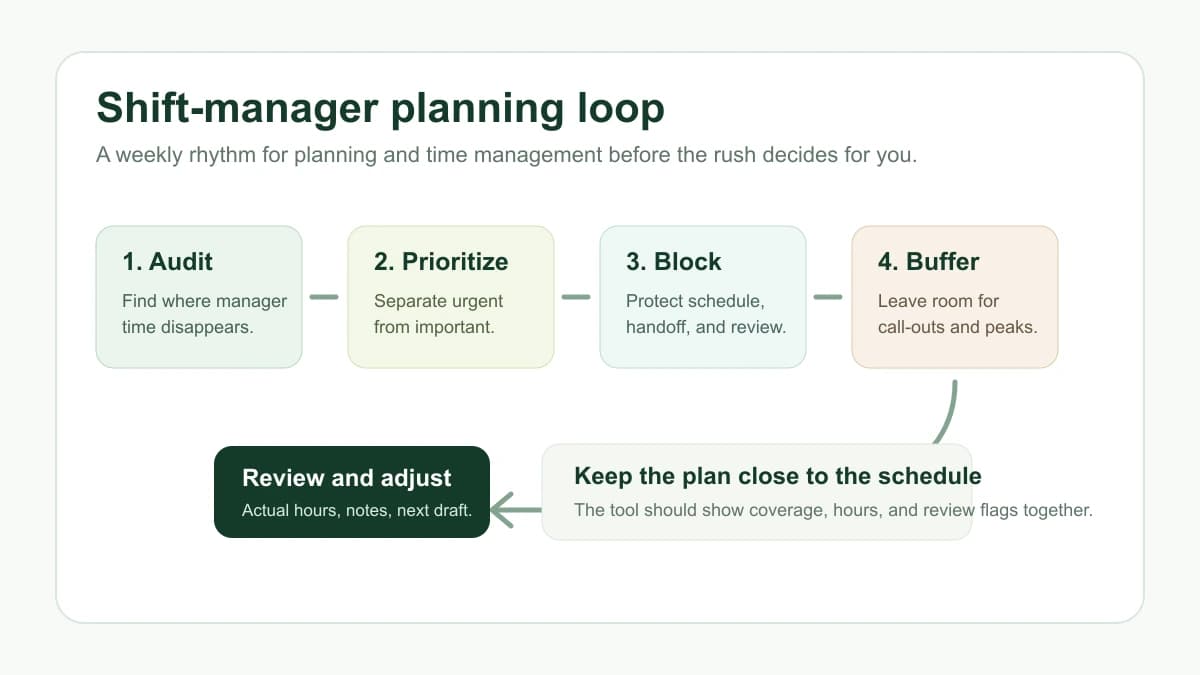
Use productivity techniques only where they fit
Pomodoro, the 3-3-3 rule, time blocking, and task batching can help with manager admin. Shift work still needs a translation layer.
Pomodoro
Use 25-minute focus blocks for admin work like drafting the schedule, reviewing availability, cleaning up employee records, or preparing export notes. Do not use it as a service rule. Guests, food safety, and staff support do not wait for a timer.
3-3-3 rule
A practical restaurant version is three protected planning tasks, three short manager follow-ups, and three maintenance checks. For example: draft schedule, review actual hours, build backup list; then message two employees and confirm a supplier issue; then check breaks, tips context, and publish status.
Task batching
Batch messages, availability review, approvals, and exports. Do not keep reopening the schedule every time one person texts.
Time blocking
Protect the schedule-building block like a meeting. If the manager always drafts between rushes with one eye on the counter, the schedule will carry that chaos into the week.
Two-minute rule
Good for tiny admin cleanup. Bad if it becomes an excuse to avoid the harder planning work. If the task changes coverage, hours, tips, or payroll notes, put it into the weekly review instead of handling it from memory.
Delegate before the rush
Delegation is not just handing work away. For shift managers, delegation means naming who owns a station, who can approve a small change, who can be called first, and who needs the note after service.
A good weekly plan should make these decisions visible: opener, closer, manager-on-duty, first backup by role, trained backup by role, cashout owner, prep priority, and who updates actual hours after a change. If those names are not written down, the rush will choose them for you.
This is also where planning protects the best employees. Reliable staff often become the default answer to every problem. Without a backup list and cross-training plan, the same person covers every hard close, every sick call, and every Saturday double. That is not time management. That is quiet burnout.
Pair this section with the restaurant shift handoff checklist and the weekly restaurant schedule review checklist if your biggest leak is between managers.
A composite week: move two decisions earlier
Consider a fictional restaurant manager who drafts the week on Wednesday afternoon. In the first version, Friday dinner has no trained expo backup and the same reliable server is the answer to Thursday close, Friday call-out coverage, and Saturday patio support.
The manager moves two decisions earlier. On Tuesday, the availability deadline closes and the first backup by role is named. On Thursday, a 20-minute review checks hard-shift rotation and weekly totals before the schedule is shared. Friday's service may still change, but the manager is no longer inventing the first response during the rush.
This is a composite operating example, not a customer case study or measured result. Its use is the sequence: move repeat decisions into the week, keep true exceptions with the manager on duty, then record what changed for the next review.
Where Maxuod Shift fits in the manager system
A general calendar can hold manager focus blocks. A task app can hold reminders. A spreadsheet can work for a very small team. But the weekly schedule needs shift-specific context: roles, availability, weekly hour totals, actual hours, tip pool notes, holiday flags, and export handoff.
Maxuod Shift covers that scheduling and review layer. A free registered account can save up to 12 active employees and 8 weeks of schedule history, with roles, recurring availability, planned and actual hours, tip calculations, pay estimates, province calendar prompts, and PDF, print, CSV, or XLSX outputs. Supporter raises the active-employee and history limits; it does not turn the product into a full HR or payroll suite.
The software cannot decide demand, judge performance, run a coaching conversation, approve leave, resolve a dispute, or guarantee legal treatment. It can keep the schedule facts and manager notes in one weekly record so those decisions are easier to prepare and hand off.
Use the free scheduler to build a real week, the restaurant schedule maker for restaurant-specific coverage, the employee hours calculator when you want a quick hour check, and the restaurant tip calculator when tip distribution needs a clean record.
Make the weekly review the habit
Planning and time management gets easier when the week has a closing loop. Before the next draft, review what happened: which shifts ran short, which employees took on too much, which notes reached payroll late, which demand forecast was wrong, and which manager task should move earlier next week.
That review should be short. Ten to fifteen minutes is enough for many small teams. The point is not a perfect meeting. The point is to stop treating every week like a brand-new emergency.
For a deeper cost view, connect the review to the restaurant labour cost percentage guide. For holiday-heavy weeks, use the Civic Holiday restaurant schedule checklist as a model for writing review flags without guessing pay treatment.
Sources rechecked on 2026-07-29: BDC time-management guidance for entrepreneurs, BDC day-organization guidance, and Canada.ca public holidays. This was an operations and content refresh. Legal content, payroll formulas, `CANADA_PAYROLL_RULES`, `ruleVersion`, and `lastVerified` were not revalidated or changed.
FAQ
How should a restaurant shift manager manage time?
Protect three kinds of time: planning time for the weekly schedule, service time for staff and guest support, and people time for coaching or training. Give the draft schedule and weekly review their own blocks so they are not rebuilt between rush interruptions.
What are the 5 P's of time management?
A practical version for shift managers is prioritize, plan, protect, perform, and pause. Prioritize the real risks, plan the week, protect schedule-building time, perform the shift work, and pause for a weekly review.
How does planning help with time management?
Planning reduces repeated interruptions. When availability deadlines, coverage targets, backup roles, holiday flags, and export notes are visible early, managers spend less time rebuilding the schedule from memory.
What is the 3-3-3 rule for time management?
For a restaurant manager, a useful 3-3-3 version is three protected planning tasks, three short follow-ups, and three maintenance checks. Use it for admin blocks, not during active service.
What is the best time management technique for a busy restaurant manager?
Use a weekly operating rhythm: close actual hours, collect availability, draft coverage by daypart, check totals and hard-shift rotation, name backups, then share the reviewed schedule at a consistent time.
Written as an operator checklist, not legal or payroll advice. Confirm local rules before changing pay, holiday, or tip policies.
Related guides
Weekly Restaurant Schedule Review: A 20-Minute Walkthrough
Review a restaurant schedule in 20 minutes with a worked walkthrough for coverage, availability, fairness, hours, backups, and payroll handoff.
Restaurant Shift Handoff Checklist: Pass the Exceptions
A restaurant shift handoff checklist for exceptions, owners, deadlines, actual-hour changes, and close-to-open decisions without a chat dump.
Restaurant Labour Cost Percentage in Canada: 2026 Cost Review
Calculate restaurant labour cost percentage, compare scheduled and actual inputs, and diagnose sales, coverage, overtime, or employer-cost changes.
Build the schedule before the week gets loud
Maxuod Shift keeps employee availability, overtime risk, payroll estimates, and tip distribution in the same place for small restaurant teams.