
By Deeyoung MaLinkedInWebsiteJuly 9, 202612 min readScheduling OperationsReviewed October 2, 2026
August 2026 Restaurant Staffing Plan: Canada Events
Review the August 2026 Canada staffing reference against actual covers, role bottlenecks and student availability before reusing its planning method.
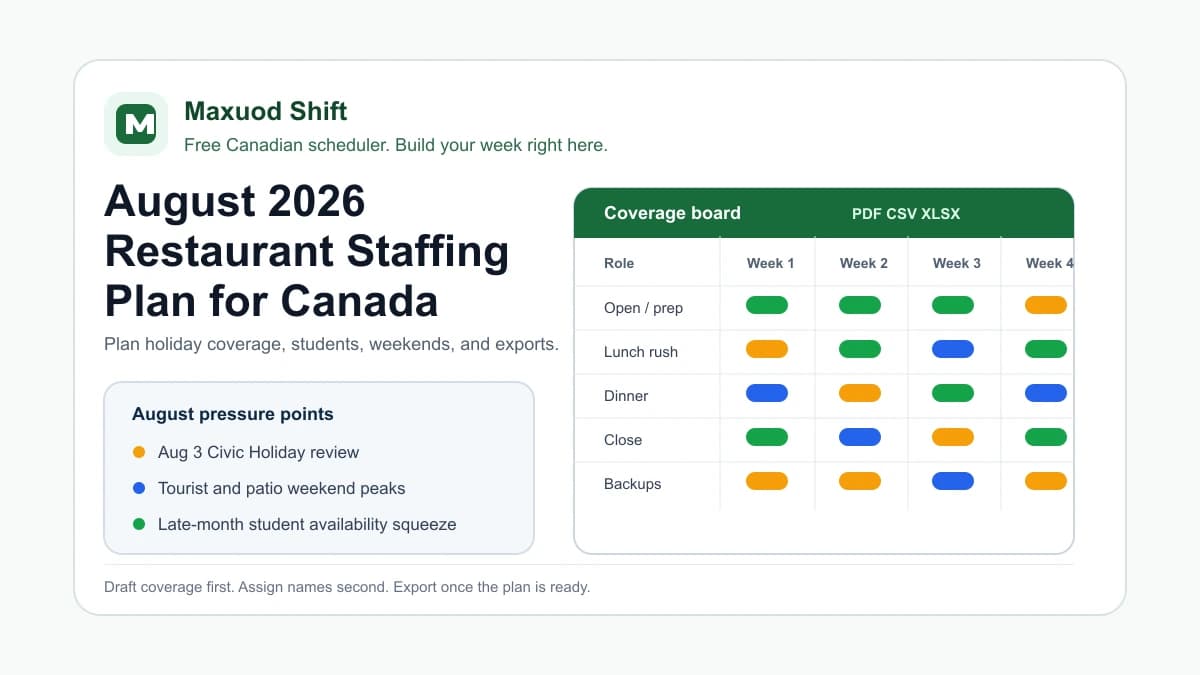
August 2026 historical reference
The July–August dates below have passed. Keep them as a record of the original planning window, not as upcoming events. For the next roster, use the current weekly scheduling method and newly confirmed local inputs. Event and legal source checks below retain their original July dates.
An August staffing plan can fail in two opposite directions. A festival, fair, or cruise call can strengthen one daypart, while smoke, flooding, a power problem, or a transport disruption can shorten service and reduce the hours actually worked. The manager needs a confirmation point for both outcomes before adding or releasing coverage.
For the July 31 to August 31 action window, use official schedules as triggers rather than forecasts. Compare each event with distance, reservations, prior sales, weather, transit routes, and the restaurant's own daypart pattern. Then name the role, the evidence required to keep the shift, and the time when the decision will be confirmed.
This working plan is for small restaurants, cafes, food trucks, bars, bakeries, and counter-service teams. The event, Port of Québec, public-holiday, and Manitoba recovery sources in this update were rechecked on July 31, 2026. Event times and operating conditions can still change.
Close the forecast before carrying its assumptions forward
Build a short review from your own closed August weeks. Pair each demand assumption with actual covers or orders by daypart, actual worked hours by role, and the reason for any departure from plan. Visitor capacity, a festival date and a sunny forecast are not evidence that your extra shift was needed.
| Original assumption | Record to inspect | Next planning decision |
|---|---|---|
| An event would lift lunch | Lunch covers and queue timing, compared with your own comparable days | Keep, shorten or remove that specific coverage block; do not copy a province-wide uplift |
| One extra server would solve the rush | Prep completion, dish backlog and closing overruns | Reassign the role if the bottleneck was elsewhere |
| Students could work through late August | Confirmed availability changes and replacement dates | Set the next availability deadline before publishing the affected week |
This is a review method, not measured results from Maxuod Shift customers. If your August records cannot separate scheduled and worked hours, mark that gap instead of claiming a labour saving. Recheck future dates and applicable pay rules independently; do not turn this URL into a different year’s forecast.
What makes August 2026 different
Canada.ca lists Civic Holiday on Monday, August 3, 2026, excluding Quebec. That calendar label does not create one uniform paid-holiday rule across Canada. Check the applicable province or territory before making a payroll decision. Labour Day follows on Monday, September 7, so late August also becomes the setup period for the next long weekend.
That creates a simple planning shape. The first week needs holiday and long-weekend coverage review. The middle weeks need tourist, patio, event, and weather coverage. The final week needs a student availability check before school routines pull people out of open shifts.
| August moment | Staffing risk | Manager action |
|---|---|---|
| Aug 1 to Aug 3 | Holiday weekend demand, changed hours, payroll review questions. | Confirm open hours, backup roles, and holiday notes before publishing. |
| Mid-August weekends | Tourist spikes, patio changes, late reservations, weather shifts. | Build baseline coverage, then add flex shifts only where demand can justify them. |
| Last full week | Students changing availability, seasonal workers leaving, training gaps. | Collect school-date updates and name replacements before the schedule is tight. |
July 31 to August 31: the manager action window
The current window contains several concentrated city events and three near-term Québec cruise calls. A confirmed date creates a review task; it does not prove that a restaurant will be busy. Match the venue, published hours, guest route, and transport pattern to the restaurant's service window before changing the roster.
| Place and official source | Confirmed 2026 window | Restaurant decision to test |
|---|---|---|
| Port of Québec cruise schedule | Volendam: August 7, 09:00 to 17:00, 1,440 passengers; Le Bellot: August 8, 08:00 to 20:00, 184; Volendam: August 9, 07:00 to 16:00, 1,440 | Test breakfast, lunch, quick-service, and early-afternoon coverage only for restaurants near the Old Port, excursion, walking, or transit route; recheck each call 24 to 48 hours before arrival |
| Halifax Busker Festival | July 29 to August 3 | Check waterfront lunch, walk-in dinner, drinks, takeout, and closing coverage against the daily schedule and weather |
| AREA 506, Saint John | July 30 to August 2 | Test pre-event dinner, bar, quick service, post-event close, and the safe-ride route rather than treating all four days alike |
| George Street Festival, St. John's | July 30 to August 5 | Protect bar support, security coordination, dish, and late-close handoff across seven nights |
| Saskatoon EX | July 30 to August 6; noon to midnight | Compare noon-to-late traffic with takeout packaging, beverages, cleanup, and closing coverage |
| Osheaga, Montréal | July 31 to August 2 | Test transit-route lunch, pre-event service, takeout, and late return traffic near the actual movement corridor |
| Toronto Caribbean Carnival | July 30 to August 2; Grand Parade August 1 | Test daytime cold drinks, fast items, packaging, cleanup, and later closing by event location and published hours |
| Folklorama, Winnipeg | August 2 to 15 | Check pavilion locations, dinner reservations, group movement, and late-night windows before adding restaurant coverage |
If the restaurant has no prior event history, add a confirmation point instead of committing a full extra shift. Check reservation pace and weather in the morning, compare sales with plan before the next daypart, and release conditional coverage only through a lawful, agreed process. A named backup with a specific role and response window is more useful than a long unconfirmed call list.
Use Québec cruise calls as timed review points
The Port of Québec schedule updated July 28 lists Volendam on August 7 from 9:00 a.m. to 5:00 p.m. with a 1,440-passenger field, Le Bellot on August 8 from 8:00 a.m. to 8:00 p.m. with 184, and Volendam on August 9 from 7:00 a.m. to 4:00 p.m. with 1,440. These are schedule fields, not a forecast of people entering a particular restaurant.
The August 7 call supports a breakfast, lunch, quick-service, and early-afternoon review. August 8 spans lunch and dinner but has a much smaller passenger field. August 9 starts earlier, so an Old Port operator may review earlier prep or opening coverage. A restaurant outside the walking, excursion, or transit route may make no change.
The practical record is the call time, the restaurant's distance and daypart assumption, the 24- to 48-hour recheck, and the condition for keeping or releasing flex coverage. Ship schedules can change with weather, tides, and port operations.
The second half of August needs one availability deadline
Three confirmed event windows make the middle and end of August worth planning before the Civic Holiday schedule is closed. Edmonton International Fringe runs August 13 to 23 with 209 indoor shows and more than 1,300 performances reported by the organizer. The Canadian National Exhibition runs August 21 to September 7, and the PNE Fair runs August 22 to September 7.
These dates are planning signals, not restaurant-demand forecasts. By August 7, collect each student or seasonal employee's final full week, school or travel start date, last available weekday shift, and continued weekend availability. That gives Edmonton, Toronto, and Vancouver managers time to resolve hard-role gaps before event and Labour Day schedules overlap.
When the signal points down instead of up
An event plan assumes the restaurant can open and guests can reach it. An emergency plan tests that assumption first. The scheduling response should change when access, power, food safety, transport, or employee travel becomes uncertain.
| Signal | Confirm before changing the roster | Scheduling move | Record after the decision |
|---|---|---|---|
| Event or reservation growth | Official time, guest route, reservation pace, weather, and comparable sales | Add a named role or agreed flex window with a confirmation and release time | Assumption, approval, published change, and actual hours |
| Weather, smoke, or transit disruption | Local authority, event organizer, transport status, safe travel, and service-area conditions | Delay, shorten, relocate, or release coverage through the applicable policy and local rules | Employee contact, changed start or end, closure note, and actual hours |
| Flood, power, access, or supply interruption | Safety, utilities, food condition, insurer, official recovery guidance, and reopening authority | Protect people and records before rebuilding the shift; do not preserve a busy-event roster when the operation cannot support it | Decision time, employee status, photos, receipts, invoices, estimates, and actual hours |
Manitoba's July 20 flood-recovery bulletin tells applicants to preserve photos, receipts, invoices, and estimates. It does not establish that every restaurant qualifies for assistance or is ready to reopen. Use the Restaurant Manager Incident Handbook to separate immediate facts, employee contact, actual hours, evidence, escalation, and reopening checks.
Build the month in three passes
Do not start by assigning names to every day. First, build the month in three passes.
- Coverage pass: write the roles each day needs before choosing employees.
- Availability pass: mark who can work, who is leaving, and who has date limits.
- Cost pass: check weekly hours, possible overtime, training time, and payroll handoff notes.
This keeps the plan from becoming a pretty calendar with weak coverage. A manager can see the real gaps before staff preferences and shift swaps make the week harder to read.
Forecast demand with ranges
A small restaurant usually does not know the exact guest count two weeks out. It can still plan with ranges. Look at last August, the same week this year, weather-sensitive patios, local events, delivery volume, and reservation pace.
Use three levels for each daypart: base, busy, and stretch. Base is the staffing you need to open safely. Busy is the normal good day. Stretch is the version where weather, tourism, a festival, or a group booking pushes the room harder than usual.
Once the dayparts are marked, keep stretch coverage conditional until the evidence is there. Check that the employee has agreed to the arrangement and that it follows the applicable scheduling and reporting-pay rules. This protects the budget without treating every sunny Friday or festival listing as the same demand signal.
Before the event window, inspect takeout containers, cup and lid pairs, cold beverages, ice, high-volume ingredients, printer paper, and quick-service packaging. Inventory cannot rescue a weak schedule, but a strong schedule cannot rescue a service line that runs out of its fastest items.
Staff roles before names
August schedules fail when the roster has people but not roles. A full-looking schedule can still miss a strong closer, a prep lead, a host, a patio server, or someone who can cover both cash and expo.
Start with the hard roles: opener, closer, manager-on-duty, prep lead, rush service, patio, dish, runner, and backup. Then add names. If one person is carrying too many hard roles in the same week, the problem is visible before the schedule goes out.
Cross-training belongs here. Pick the two roles most likely to break during August and train one extra person for each. Keep it small. Training every person on every station sounds tidy, but managers usually need two backup moves they can trust under pressure.
Collect student and seasonal availability early
Late August availability changes should not arrive one text at a time. Set a deadline for school dates, travel dates, second-job changes, and last available shifts.
Ask seasonal staff three direct questions: their final full week, the shifts they can still cover after that date, and whether they want future holiday or weekend shifts. This gives the manager a replacement plan instead of a resignation surprise.
If a student can work only weekends after mid-August, mark that before assigning them weekday closes. If a seasonal employee is leaving before Labour Day prep starts, do not build the first September draft around them.
Keep labour rules as review notes
Restaurants in Canada usually need provincial or territorial employment-standards review, and the details differ. Minimum wage, overtime, breaks, rest periods, public holiday treatment, and youth employment rules should be checked against the current source for the province where the employee works.
The schedule should not try to be a lawyer. It should show the manager where review is needed: long shifts, close-to-open turns, holiday work, people near overtime, break coverage, and manual changes after publishing.
For official context, check the relevant province or territory employment-standards page. Sources rechecked on July 31 include British Columbia hours and breaks, Alberta hours of work and rest, Alberta general holidays, Manitoba general holidays, and Nova Scotia breaks and rest periods.
Make swaps and backups visible
A swap plan is part of the staffing plan. If swaps happen in a chat thread and the schedule never changes, the manager loses the record that payroll and the next shift lead need.
Name backups by role, not only by person. One backup closer, one backup rush server, one backup dish or support person, and one manager who can approve changes will solve more problems than a long list of maybe-available names.
After a swap, record who changed, what time changed, who approved it, and whether the weekly total needs review. This is dull work, but it is the work that prevents August chaos from reaching payroll.
Move the August draft into a changeable weekly record
A paper plan or spreadsheet is fine for the first draft. Once the week starts moving, a live schedule is easier to maintain.
Start the week in the free scheduler. A registered Free account can save the roster, keep roles visible, and preserve planned and actual hour totals as the week changes. Add the event assumption and release time to the manager notes so the extra lunch, bar, takeout, dish, or close coverage has a reason attached to it.
After the shift, compare the final worked time with the roster. Use the employee hours calculator for a quick independent total, then move approved hours, overtime review notes, tips, and exceptions through the weekly payroll handoff checklist. PDF, print, CSV, and XLSX exports preserve the record for the manager or bookkeeper.
Maxuod Shift does not import live festival attendance, cruise passenger movement, weather, reservations, or POS sales. It does not decide whether an on-call or reporting arrangement is lawful. The manager still checks the official source and local demand, confirms employee availability, and applies the relevant provincial or territorial rules.
The point is not to turn a small restaurant into a large HR department. It is to keep the schedule, the reason for each change, actual hours, review notes, and the approved handoff connected once August starts moving.
August staffing checklist
- Confirm the official event, port, weather, transport, or emergency status and note when it was checked.
- Filter an event by the restaurant's distance, guest route, daypart, reservations, weather, and prior sales.
- Confirm August open hours and add a Civic Holiday payroll-review note where relevant.
- Map base, busy, and conditional stretch coverage for lunch, dinner, bar, takeout, dish, and close.
- Name the evidence and time required to keep or release conditional coverage.
- Check packaging, beverages, high-volume ingredients, utilities, and fast-service inventory.
- Assign hard roles before names, then confirm backups and any conditional coverage directly.
- Collect student and seasonal availability by the restaurant's August deadline.
- Review long shifts, breaks, reporting-pay questions, holiday notes, and overtime exposure.
- Record changes and actual hours, then complete one approved payroll handoff.
Start with the location filter. It prevents a national event list from becoming an expensive roster that does not match the restaurant's real traffic.
Source note and limits
Event, port, and recovery sources checked on 2026-07-21: Port of Québec, Halifax Busker Festival, AREA 506, George Street Festival, Saskatoon EX, Osheaga, Toronto Caribbean Carnival, Folklorama, Edmonton International Fringe, the Canadian National Exhibition, the PNE Fair, and Manitoba's flood-recovery bulletin. Event times, ship calls, transport, and operating conditions can change, so reopen the source before finalizing coverage.
The Port of Halifax cruise schedule could not be accessed during the July 21 recheck, so the previously reported Halifax passenger-capacity figures were removed from this update rather than presented as current. Canada.ca's 2026 public-holiday calendar was rechecked on July 21. Most restaurants are governed by provincial or territorial employment standards, so the applicable local source still controls payroll review.
This article is an operations planning guide, not a demand forecast, payroll result, legal opinion, safety clearance, insurance decision, or disaster-assistance eligibility decision. Maxuod Shift records and exports manager inputs; it does not make those decisions.
FAQ
What should an August 2026 restaurant staffing plan include?
It should include source-check times, Civic Holiday coverage, event and disruption scenarios, student and seasonal availability dates, hard-role coverage, backup staff, actual-hours review, and one approved payroll handoff.
Why is August different for Canadian restaurants?
August combines holiday-weekend planning, tourism and patio demand, local events, weather swings, and late-month student availability changes before September schedules begin.
Does this staffing plan calculate holiday pay or overtime?
No. It is an operations plan. Holiday pay, overtime, breaks, rest periods, and other employment-standards questions should be checked against the current source for the province or territory where the employee works.
Can Maxuod Shift help with the August staffing plan?
Yes. A free registered Maxuod Shift account can help small teams build schedules, save weeks, review planned and actual hours, attach manager notes, print or download PDF copies, and export schedule data in CSV or XLSX format. The employee hours calculator and weekly payroll handoff checklist support the final review. Maxuod Shift does not forecast event, cruise, weather, or emergency outcomes.
Should a restaurant add staff for every nearby festival?
No. Filter the event by distance, guest movement, published hours, reservations, weather, prior sales, and the restaurant's own daypart pattern. Event size is a demand signal, not proof that a particular restaurant will be busy.
How should a restaurant adjust event staffing when weather or an emergency changes the plan?
Recheck the local authority, event, transport, access, utility, and food-safety status before protecting extra coverage. Delay, shorten, reassign, or release shifts only through the applicable policy and local rules, then record employee contact, the changed start or end time, the reason, and actual hours.
Written as an operator checklist, not legal or payroll advice. Confirm local rules before changing pay, holiday, or tip policies.
Related guides
Summer 2026 Restaurant Scheduling Guide for Travel Season
Plan restaurant schedules for the Summer 2026 travel season: patios, tourist weekends, student staff, weather swings, long weekends, and backup coverage.
Free Shift Schedule Templates: Blank PDF Download
Download a blank shift schedule template PDF for weekly planning, then use a free Maxuod Shift account when you need saved schedules and PDF, CSV, or XLSX exports.
Weekly Restaurant Schedule Review: A 20-Minute Walkthrough
Review a restaurant schedule in 20 minutes with a worked walkthrough for coverage, availability, fairness, hours, backups, and payroll handoff.
Build the schedule before the week gets loud
Maxuod Shift keeps employee availability, overtime risk, payroll estimates, and tip distribution in the same place for small restaurant teams.