
By Deeyoung MaLinkedInWebsiteJuly 17, 20269 min readPayroll & TipsReviewed July 17, 2026
Saskatchewan Tip Law 2026: What Restaurants Must Change
Saskatchewan's 2026 tip law limits withholding, permits disclosed tip pools, and requires records. See what restaurant operators should update.
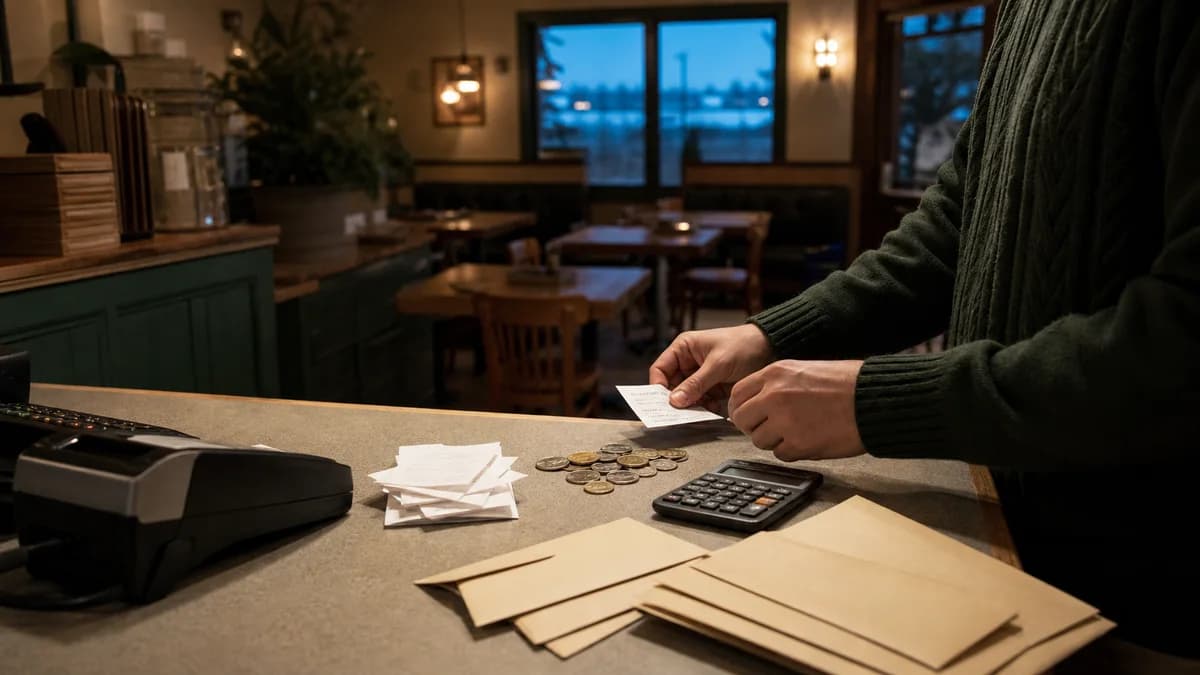
Saskatchewan restaurants began 2026 with a new rule for employee tips. Since January 1, an employer generally cannot withhold an employee's gratuities, deduct from them, or make the employee return them to the business. Money taken contrary to that rule can be recovered through the province's wage-collection process.
That does not mean every server must keep every dollar placed on their table. Saskatchewan still permits an established tip pool. It also permits a proprietor, partner, director, or shareholder to share in the pool when that person regularly performs the same work as employees who receive or share the tips. The practical change is narrower and more useful: the business needs a disclosed arrangement, a defensible calculation, and records that show what happened.
This article separates the provincial ownership rule from the federal tax question, then works through one restaurant close. It is an operator briefing, not legal or payroll advice.
The Saskatchewan rule took effect on January 1, 2026
The province passed the employment-standards amendments in May 2025. A later Government of Saskatchewan release set January 1, 2026 as the in-force date.
Section 2-36.1 of The Saskatchewan Employment Act now bars an employer from directly or indirectly withholding gratuities, deducting from them, or causing an employee to return or give those gratuities to the employer, except where another law or the Act permits it. A contravening amount becomes a debt to the employee and is deemed to be wages for recovery purposes.
The province's current Protection of Gratuities and Tips guidance adds the operating detail. A restaurant cannot keep tips to pay for theft, errors, damage, or wages. It can establish a pool, but staff must be made aware of the arrangement and the arrangement record must be kept for two years after it ends.
What the new rule permits, and what it blocks
The safest way to read the Saskatchewan tip law is by action, not slogan. The law protects employee gratuities while preserving a documented way to redistribute them.
| Restaurant action | Current Saskatchewan position | Record to keep |
|---|---|---|
| Keep tips for a walkout, broken item, error, or wages | Not permitted by the provincial guidance | Do not build these costs into the tip policy |
| Require tips to enter a pool for redistribution | Permitted under an established pooling arrangement | Participants, contributions, distribution rule, notice method, and effective dates |
| Let an owner, director, or shareholder share in the pool | Permitted when that person regularly performs the same work as participating employees | Role, work performed, eligible hours, and the same formula applied to comparable work |
| Deduct an amount required by statute | Permitted only to the extent required and remitted to the proper authority | Payroll classification, deduction calculation, and remittance record |
| Require wages to be contributed to the tip pool | Not permitted | Keep wage and tip records separate |
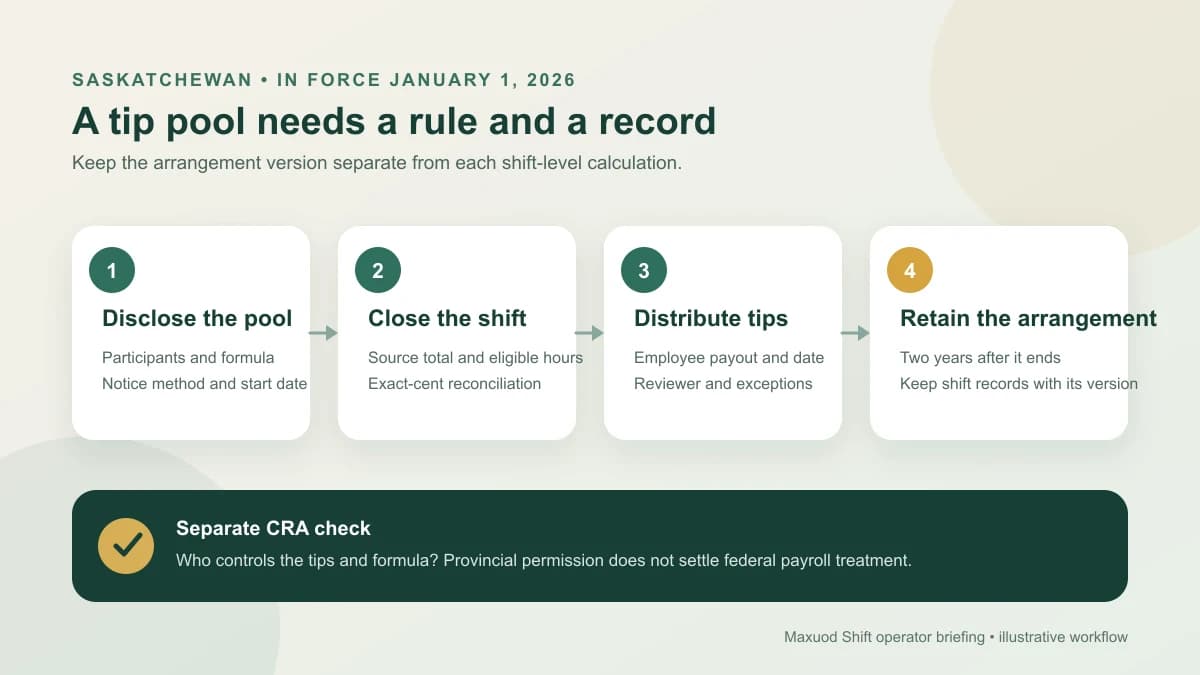
Notice can be posted in a visible workplace location, placed on a secure employee website, or delivered another way that ensures employees know the arrangement. The point is not a signature for its own sake. An employee should be able to tell who participates, what enters the pool, which formula applies, and when the rule changed.
One dinner shift shows what the record needs
Consider a fictional Regina restaurant with a $450 dinner pool. Its written policy uses eligible hours for servers, bartenders, and the scheduled kitchen closer. Maya worked 7 eligible hours, Noah 6, Lina 5, and Theo 6. The 24 eligible hours produce a rate of $18.75 per hour.
| Employee | Eligible work | Hours | Calculated payout |
|---|---|---|---|
| Maya | Server | 7.00 | $131.25 |
| Noah | Server | 6.00 | $112.50 |
| Lina | Bartender | 5.00 | $93.75 |
| Theo | Kitchen closer | 6.00 | $112.50 |
| Total | 24.00 | $450.00 |
The arithmetic is the easy part. The useful record also identifies the service date, source total, eligible participants, policy version, formula, any required deductions, payout date, and reviewer. Saskatchewan requires the pooling-arrangement record to be retained for two years after the arrangement ends. Its guidance recommends tracking the money collected and redistributed because those details can clarify a complaint.
If the restaurant changes from hours-only to role-weighted distribution next month, close the old policy with an end date and retain it. Do not silently edit the formula and leave last month's payouts attached to a rule that did not exist at the time.
Provincial protection and CRA treatment are separate questions
Saskatchewan decides what the employer may do with gratuities. The Canada Revenue Agency decides how tips are treated for income tax, CPP, EI, and T4 reporting. A restaurant can follow the provincial ownership rule and still mishandle the federal payroll side.
The CRA's current tips received by employees guidance calls tips controlled when the employer controls or possesses them and then pays employees. Examples include an employer-determined sharing formula, tips turned over to the employer for distribution, or cash tips deposited into the business account. Controlled tips require income-tax, EI, and CPP withholding and T4 reporting.
Direct tips follow a different route. The CRA examples include a tip paid directly to an employee and a pool whose sharing decision is made by employees rather than the employer. The employer does not withhold or report direct tips, but the employee still has to report the income.
Do not use the provincial permission to run a tip pool as the answer to the CRA classification. Document who controls the money and formula, then confirm the payroll treatment for the restaurant's actual process.
Nova Scotia has a proposal, not the same law
The recent Atlantic Canada discussion may be the source of the province-name confusion. Nova Scotia Bill 234 proposes protections for tips and service charges, written tip-pool policies, and tip records. Its text says it would have effect on and after January 1, 2027 if enacted in its current form.
As of July 17, 2026, the Legislature's bill page shows only First Reading on March 6, 2026. There is no listed Royal Assent. Bill 234 is therefore not a current Nova Scotia tip law, and an operator should not present the proposed January 2027 date as settled law.
Current Nova Scotia Protecting Pay guidance states that pay does not include tips and gratuities. A clear policy and complete payout record are still useful operating practices in Nova Scotia, but Saskatchewan's 2026 statutory protection should not be copied over as if it already applied there.
Use the calculator to make the split reviewable
Fair treatment is easier to trust when an employee can see the same inputs and result as the manager. The free Maxuod Shift restaurant tip pool calculator opens with a sample team, so there is no blank setup screen. Replace the sample total, names, roles, and eligible hours with the shift being closed, then choose Hours or Role % + hours.
| What the tool displays | Why it helps the restaurant |
|---|---|
| Each employee's name, role, eligible hours, share percentage, and calculated payout | The manager and employee can trace a payout back to the disclosed inputs |
| Role percentages in the setup and the assigned role on each employee result | Service, kitchen, bar, and support treatment is visible instead of buried in a formula |
| A clear rule for a funded role with no worked hours | The share is redistributed, kept unallocated, or sent to a named fallback role; it never moves silently |
| Total pool, distributed total, and a visible alert for any unallocated amount | The close shows whether every cent is accounted for before anyone is paid |
The calculation runs in the browser without registration. Whole-cent allocation makes the employee rows reconcile with the pool, including remainder cents. When the result is ready, PDF and CSV downloads include the method, employee breakdown, and totals. The PDF is convenient for a review or printed close packet; the CSV fits a spreadsheet or payroll handoff. Either file gives staff something clearer to inspect than a verbal number at the end of a busy shift.
For recurring use, a free Maxuod Shift account connects tip work to saved employees and schedule weeks. That reduces repeated entry and keeps the tip record beside the hours that produced it. The public calculator remains useful for a one-time pool or for testing a policy before the restaurant moves it into a saved workflow.
The tool does not decide which jobs are legally eligible, whether an owner performed comparable work, whether a policy was properly disclosed, or whether the tips are controlled or direct for CRA purposes. It also does not transmit the payout. Set those rules first, run the calculation second, invite the employee to review the breakdown, and keep the downloaded record with the applicable policy version.
For a written-policy starting point, use the Canadian restaurant tip pooling policy template. For a wider comparison, read the province-by-province tip pooling guide, then return to Saskatchewan's official guidance before changing a live process.
Change the record before the next dispute
A Saskatchewan restaurant does not need a longer policy. It needs a policy employees can find and a record that can be reconstructed.
- Remove any rule that uses employee tips to absorb walkouts, damage, errors, or wages.
- Publish the pool participants, contribution method, distribution formula, effective date, and change process.
- If a proprietor, partner, director, or shareholder participates, record the comparable work and eligible hours.
- Confirm whether the real workflow creates controlled or direct tips for CRA purposes.
- Retain each version of the pooling arrangement for two years after it ends, and keep the shift calculations that show how it was applied.
The new Saskatchewan rule is not a ban on teamwork or tip pooling. It is a ban on treating employee gratuities as a convenient business account. A disclosed rule, an exact-cent calculation, and a dated record make that boundary visible before anyone has to argue about it.
For owner participation, card-fee questions and tax treatment outside this province, use the Canadian tip pooling policy checks. Saskatchewan’s rule is not a nationwide template; confirm the location before approving a payout.
FAQ
Can a Saskatchewan employer keep employee tips?
Generally no. Since January 1, 2026, an employer cannot withhold, deduct from, or require the return of employee gratuities except where the Act or another law permits it. An established tip pool and required statutory deductions are important exceptions.
Can a Saskatchewan restaurant require tip pooling?
Yes. The province says an employer may require tips to enter an established pooling arrangement for redistribution. Employees must be made aware of the arrangement, and the employer must keep its record for two years after it ends.
Can a restaurant owner participate in the tip pool?
A proprietor, partner, director, or shareholder may participate when they regularly perform the same work as employees who share or receive tips from the pool. Record the work and apply the disclosed formula consistently.
Are tips wages in Saskatchewan?
Tips are not wages for calculating hourly wages, overtime, vacation pay, public-holiday pay, or pay instead of notice under the provincial Act. Unlawfully taken tips can still be recovered like wages, and tips remain employment income under federal tax rules.
Written as an operator checklist, not legal or payroll advice. Confirm local rules before changing pay, holiday, or tip policies.
Related guides
Tip Pooling in Canada: Check the Policy Before the Payout
Before splitting restaurant tips, check who can share, card fees, payout timing and tax treatment. Canadian province differences with a worked payout example.
How to Split Tips Fairly in Restaurants
Compare tip pooling, tip sharing, and hours-based splits. Build a fair tip policy your restaurant team can understand and audit.
Restaurant Tip-Pooling Policy Template for Canada
Document tip sources, eligible roles, allocation math, exact-cent review, exceptions, approval, and payroll handoff with a bilingual-ready policy template.
Turn the reviewed tip policy into a payout record
Enter the approved pool, roles, and eligible hours, then review the exact-cent result before payroll handoff.