
By Deeyoung MaLinkedInWebsiteJuly 16, 20268 min readScheduling OperationsReviewed July 16, 2026
JUKAI Case Study: Faster Restaurant Scheduling and Tip Closeout
See how JUKAI Japanese & Thai simplified daily scheduling, tip calculations, stat-holiday planning, and Nova Scotia review with Maxuod Shift.
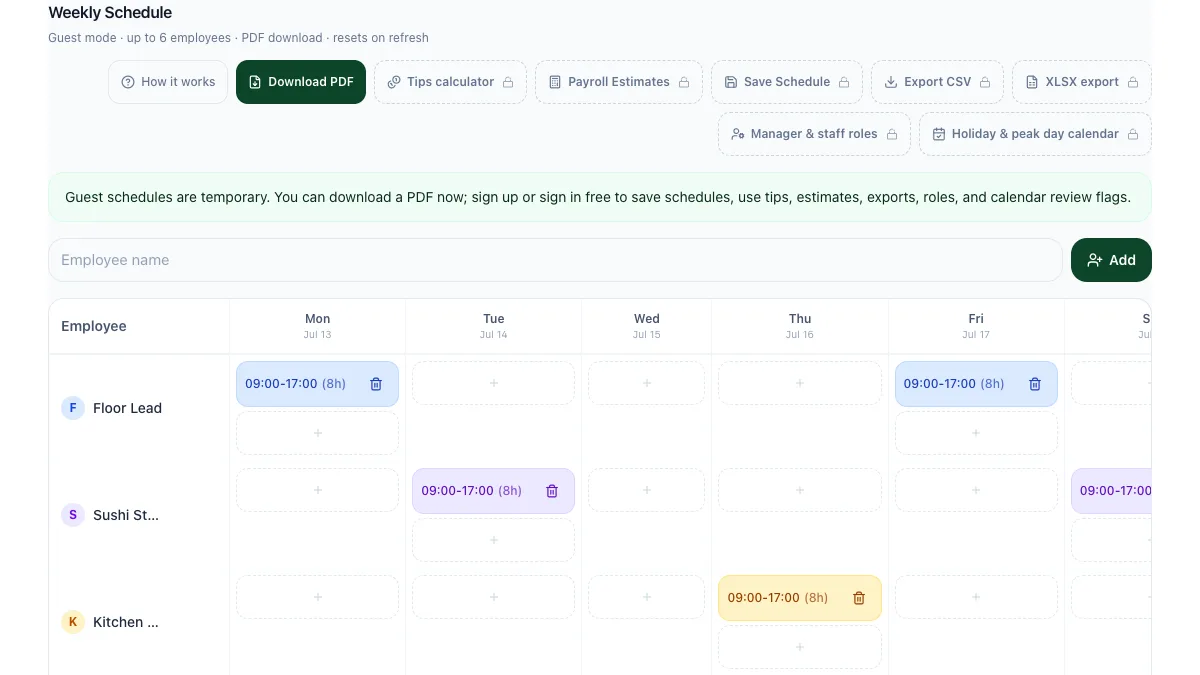
JUKAI Japanese & Thai did not need another blank schedule. The Dartmouth restaurant needed a quicker way to adjust daily coverage, keep the week's changes together, calculate tips with less repeated setup, and notice Nova Scotia review points before the schedule reached payroll.
Using Maxuod Shift shortened the time JUKAI spent preparing and adjusting daily staffing. It also simplified the path from scheduled work to tip calculation and made statutory-holiday changes easier to review. Those are directional results from the restaurant's actual use; this case study does not attach an invented minute count or percentage to them.
JUKAI is already publicly identified as a Maxuod Shift customer and local restaurant partner. Its official website shows a seven-day Dartmouth operation with different opening patterns across the week. The case study below uses the publication brief supplied by Maxuod Shift's owner and omits employee names, wages, tip totals, private schedules, and unverified numerical claims.
The operating problem was larger than the schedule grid
Restaurant scheduling is rarely one task. A manager assigns open, service, kitchen, support, and close coverage; handles a change; checks the employee's week; records what actually happened; then uses those hours again during tip and payroll preparation.
When those steps live in separate notes or spreadsheets, each correction creates another handoff. A shift change must be copied into the roster, remembered during the tip close, and explained again when holiday or overtime questions appear. The time cost comes from rebuilding context, not only from typing a start and end time.
For JUKAI, the useful change was a shared weekly record. Employees, roles, shifts, hours, tip groups, and review notes could be handled as parts of the same operating week rather than as unrelated admin jobs.
Daily schedule changes now begin with visible coverage
The manager can start with the existing week, see who is assigned on each day, and adjust the relevant shift instead of rebuilding a daily roster from memory. Weekly totals update with the schedule, so a coverage change is also an hours review.
That shortened JUKAI's scheduling work in practical terms: fewer repeated entries, a clearer current version, and less time spent reconstructing what changed. Maxuod Shift did not remove the manager's judgment. It made the information needed for that judgment visible in one place.
The cover image is a new first-party Maxuod Shift screenshot using illustrative role names. It demonstrates the workflow without exposing JUKAI's employee records. Restaurants can test the same interaction in the free restaurant schedule maker before creating an account.
Tip calculations became part of the weekly close
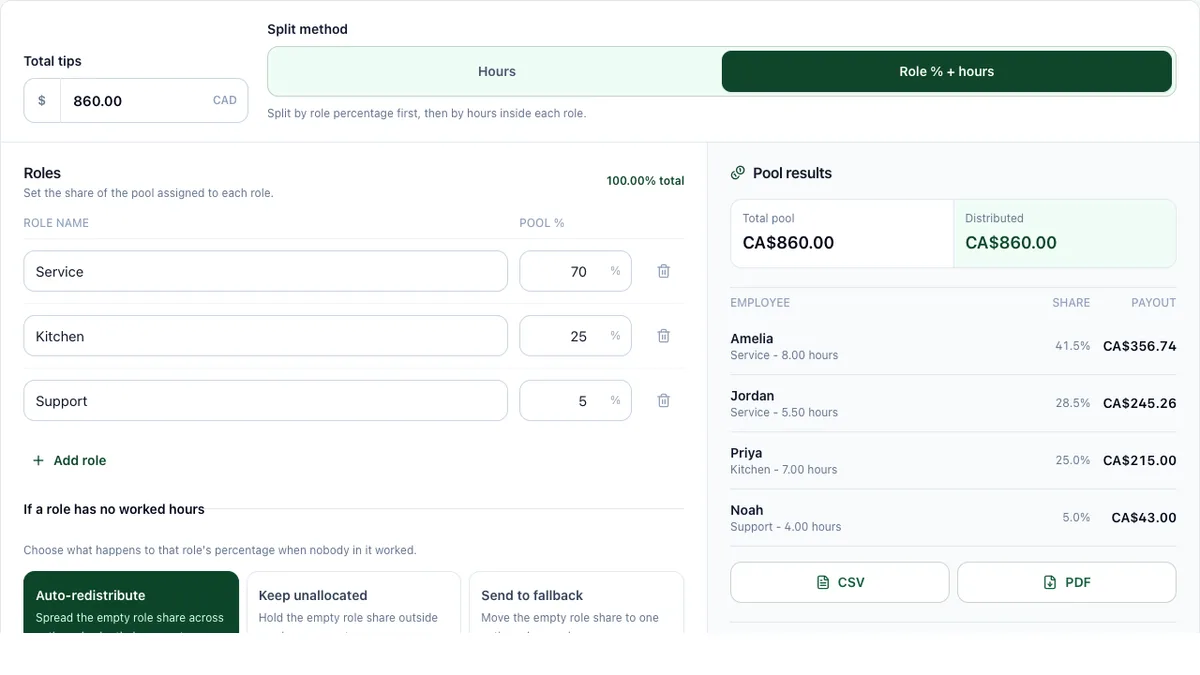
JUKAI also reduced the time spent preparing tip calculations. Instead of treating the tip pool as a separate exercise with a fresh employee-and-hours setup, the manager could work from the roles and hours already connected to the week.
The calculation still needs an approved tip total, eligible hours, the restaurant's written distribution method, and a rule for a funded role with no worked hours. Maxuod Shift supports an hours split and a role-percentage-plus-hours split, keeps unallocated amounts visible, and reconciles the result to exact cents. It does not decide who should participate or replace the restaurant's policy.
That boundary matters in Nova Scotia. The province's Protecting Pay guidance says tips and gratuities are not protected as pay under the Labour Standards Code. A documented internal policy and a reviewable calculation are therefore operational controls; the software is not a legal ruling on ownership or distribution.
Stat days became a scheduling decision before payroll
JUKAI used the statutory-holiday context to change staffing plans before the week was final. The practical question was not only whether a date appeared on a calendar. The manager also needed to decide operating hours, expected coverage, who was scheduled immediately before and after the holiday, and which records would need a payroll review.
Nova Scotia's Holiday Pay guidance lists six holidays with pay for qualifying employees: New Year's Day, Nova Scotia Heritage Day, Good Friday, Canada Day, Labour Day, and Christmas Day. Remembrance Day is handled under separate legislation. Eligibility and treatment depend on facts such as the employee's paid days and scheduled shifts around the holiday.
Maxuod Shift surfaces the holiday week and review context so the manager can adjust coverage and preserve a note. It does not automatically prove eligibility or final holiday pay. JUKAI still owns the operating decision, and payroll still owns the final treatment.
Nova Scotia context narrowed the review to the right questions
Generic scheduling software can show hours. A Nova Scotia restaurant also needs to know which totals and patterns deserve a second look. The workflow focused JUKAI's review on four concrete questions:
| Nova Scotia review point | What the official source says | What the manager checks in the week |
|---|---|---|
| Weekly overtime | The general rule is 1.5 times regular wages after 48 hours in a consistent seven-day week, with special rules and exclusions for some employees. | Employees approaching 48 worked hours, plus classification or exception questions that need payroll review. |
| Break timing | An employee is generally entitled to an unbroken half-hour break so they do not work more than five consecutive hours without a break. | Long service or close shifts where coverage must exist while the employee takes the break. |
| Weekly rest | Under normal circumstances, employees receive at least 24 consecutive hours of rest in every seven days. | Schedule sequences that put the same person on too many consecutive days. |
| Holiday qualification | Qualification and pay depend on the statutory test and the employee's actual scheduled-work facts. | The shifts immediately before, on, and after the holiday, plus the final actual-hours record. |
The current official references are Nova Scotia's Overtime Pay, Breaks and Period of Rest, and Holiday Pay pages, checked on 2026-07-16. Exceptions, collective agreements, job classifications, actual hours, and individual circumstances can change the result.
What changed, and what this case study does not claim
| Confirmed from the JUKAI use brief | Not claimed without measurement |
|---|---|
| Less time spent preparing and adjusting daily staffing | A specific number of minutes, hours, or percentage saved |
| A simpler schedule-to-tip workflow | A guaranteed reduction in payroll errors or labour cost |
| Faster tip calculation preparation | A claim that software decides the restaurant's tip policy |
| Schedule changes informed by stat-day context | Automatic proof of holiday-pay eligibility or compliance |
| More focused Nova Scotia review prompts | Legal advice or a replacement for payroll review |
This distinction is deliberate. A useful customer case study should show the operational change that actually occurred and stop where the evidence stops. JUKAI's result is a cleaner weekly process, not an invented ROI headline.
What Maxuod Digital added beyond a blank scheduler
A blank grid would not have connected JUKAI's scheduling, tip close, stat-day change, and Nova Scotia review. Maxuod Digital's product work was to keep those decisions inside one weekly sequence: build coverage, update the current version, review hours, calculate or export tips, flag province-specific questions, and preserve a handoff record.
The implementation boundary is equally important. Maxuod Shift can organize the facts and make exceptions visible. The restaurant confirms availability and actual hours, owns its tip policy, decides coverage, and approves the week. Payroll or a qualified adviser confirms final overtime, holiday, tax, and legal treatment when the facts require it.
The next measurement step is not a marketing estimate. JUKAI can record schedule-preparation time, late corrections, tip-close preparation time, and payroll questions for several comparable weeks. Only then would a numerical improvement claim be supportable.
A practical pilot for another small restaurant
Do not migrate every historical record first. Test one real upcoming week. Add the active team and roles, build the schedule, record one change, review the stat-day or province prompts that apply, and run one tip close with the approved hours.
At the end of the week, compare the workflow with the previous method: how many times was information re-entered, how long did schedule preparation and tip close take, which exceptions needed clarification, and did the final export contain what payroll needed? Keep the new process only if it reduces real manager work without hiding decisions.
You can start with the online shift scheduler or the free restaurant tip calculator. Create a free account when the week needs saved employees, history, actual-hour review, tips, and exports.
The result worth copying is one connected week
JUKAI's strongest result is not a single feature. It is the removal of repeated setup between daily staffing, schedule changes, tip calculation, stat-day planning, and Nova Scotia review.
For another restaurant, the best first test is simple: put one real week into Maxuod Shift and measure whether the manager reaches a clean schedule, tip record, and payroll handoff with fewer repeated steps. That is the standard this case study supports.
FAQ
How does JUKAI use Maxuod Shift?
JUKAI uses Maxuod Shift to simplify daily and weekly staffing changes, keep schedule context together, prepare tip calculations with less repeated setup, adjust coverage around statutory holidays, and focus Nova Scotia review questions.
Did Maxuod Shift reduce JUKAI scheduling and tip-calculation time?
Yes, directionally. JUKAI reported less time spent preparing and adjusting staffing and a shorter tip-calculation workflow. No specific minute, hour, percentage, or financial result is claimed because no comparable measured baseline was supplied.
Which Nova Scotia rules were considered in the workflow?
The review focused on the general 48-hour weekly overtime threshold, break timing before more than five consecutive hours, the normal 24-hour rest period in seven days, and holiday-pay qualification and scheduling facts.
Does Maxuod Shift guarantee Nova Scotia labour compliance?
No. Maxuod Shift organizes schedules, hours, estimates, exports, and province-aware review prompts. The restaurant and its payroll or legal advisers must verify employee classification, exceptions, actual hours, holiday eligibility, tip policy, and final treatment.
Can another small restaurant test the same workflow for free?
Yes. The public scheduler and tip calculator work without signup. A free account adds saved employees, weekly history, actual-hour review, tips, PDF and spreadsheet exports, and province-aware review prompts within the current Free limits.
Written as an operator checklist, not legal or payroll advice. Confirm local rules before changing pay, holiday, or tip policies.
Related guides
Nova Scotia Restaurant Scheduling Rules
A practical Nova Scotia restaurant scheduling guide: 48-hour overtime, breaks after 5 hours, holiday pay, call-ins, and records.
Tip Pooling in Canada: Check the Policy Before the Payout
Before splitting restaurant tips, check who can share, card fees, payout timing and tax treatment. Canadian province differences with a worked payout example.
Weekly Restaurant Schedule Review: A 20-Minute Walkthrough
Review a restaurant schedule in 20 minutes with a worked walkthrough for coverage, availability, fairness, hours, backups, and payroll handoff.
Build the schedule before the week gets loud
Maxuod Shift keeps employee availability, overtime risk, payroll estimates, and tip distribution in the same place for small restaurant teams.